Protection Features
Desktop power supply units (PSUs) include several protection features to safeguard both the PSU itself and the connected PC components (motherboard, CPU, GPU, drives, etc.). These protections prevent damage from electrical faults, overloads, or abnormal conditions.
| OCP (Normal @ 28.0°C) | 12V: 92.00A (110.44%), 12.000V 5V: 26A (130.00%), 5.069V 3.3V: 25.9A (129.50%), 3.321V 5VSB: 4.3A (172.00%), 4.933V *High Ripple (>200mV) |
| OCP (Hot @ 41.2°C) | 12V: 89.00A (106.84%), 11.989V 5V: 26.1A (130.50%), 5.075V 3.3V: 25.8A (129.00%), 3.322V 5VSB: 4.4A (176.00%), 4.873V *High Ripple (>200mV) |
| OPP (Normal @ 28.4°C) | 1199.08W (119.91%) |
| OPP (Hot @ 41.6°C) | 1151.07W (115.11%) |
| OTP | ✓ (116°C @ 12V Heatsink) |
| SCP | 12V to Earth: ✓ 5V to Earth: ✓ 3.3V to Earth: ✓ 5VSB to Earth: ✓ -12V to Earth: ✓ |
| PWR_OK | Proper Operation |
| UVP (Full Load @ 90V) | ✓ |
| UVP (No Damage @ 80V) | ✓ |
| Conducted Emissions EN55032 & CISPR 32 | ✗ |
| NLO | ✓ |
| Fan Failure Protection | ✗ |
| SIP | Surge: MOV Inrush: NTC & Bypass Relay |
The OCP triggering points on the 12V rail are highly conservative. The minor rails have similar OCP triggering points at both normal and high operating temperatures, which is inappropriate and weakens the respective protection features. Moreover, the 5VSB rail should have a lower OCP threshold to prevent excess ripple on the same rail. The Overpower triggering points are correctly set, and the rest of the protection features, but fan failure, are present. Unfortuately the latter is usually not included in desktop PSUs.
EMC Pre-Compliance at a Glance
Every electronic device, including PSUs, can be an EMI source, and the amount of EMI it emits can affect the proper operation of nearby devices. EMI can, in some extreme cases, even render them unusable. Some standards have been established to minimize electromagnetic interference (EMI) noise. The corresponding standards for IT (Information Technology) products are CISPR 32 and its derivative, EN 55032, which applies to products sold in the EU. In the EU, every product bearing the “CE” marking must comply with EN 55032. CISPR 32 and EN 55032 standards categorize devices into two classes: A and B. Class B equipment is intended for domestic environments. Hence, its permitted EMI emissions are significantly lower than those of A-class devices.
Our equipment for EMI readings:
- TBMR-110M EMI-Analyzer DC-110 MHz
- Tekbox TBLC08 LISN
- Tekbox TBFL1 transient limiter
- Tekbox software
| CISPR 32 / EN55032 Limits | ||
| CISRP 32 / EN 55032 Class A Conducted EMI Limit | ||
| Frequency of Emission (MHz) | Conducted Limit (dBuV) | |
| Quasi-peak | Average | |
| 0.15 – 0.50 | 79 | 66 |
| 0.50 – 30.0 | 73 | 60 |
| CISPR 32 / EN 55032 Class B Conducted EMI Limit | ||
| Frequency of Emission (MHz) | Conducted Limit (dBuV) | |
| Quasi-peak | Average | |
| 0.15 – 0.50 | 66 – 56 | 56 – 46 |
| 0.50 – 5.00 | 56 | 46 |
| 5.00 – 30.00 | 60 | 50 |
| CISRP 32 / EN 55032 Class A 10-Meter Radiated EMI Limit | ||
| Frequency of Emission (MHz) | Field Strength Limit (dBuV/m) | |
| 30 – 88 | 39 | |
| 88 – 216 | 43.5 | |
| 216 – 960 | 46.5 | |
| > 960 | 49.5 | |
| CISRP 32 / EN 55032 Class B 3-Meter Radiated EMI Limit | ||
| Frequency of Emission (MHz) | Field Strength Limit (dBuV/m) | |
| 30 – 88 | 40 | |
| 88 – 216 | 43.5 | |
| 216 – 960 | 46.0 | |
| > 960 | 54.0 | |
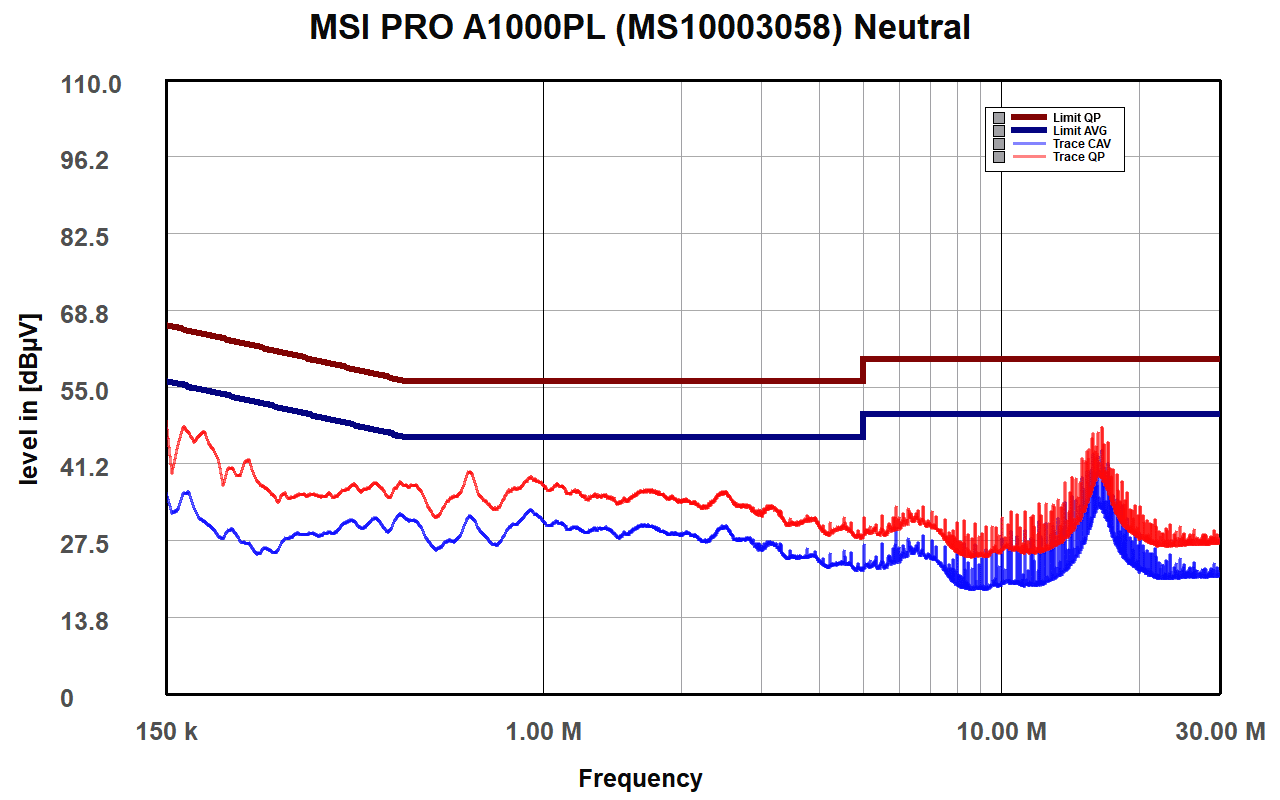
Please note that the ATX spec allows a 4 dB margin for conducted and radiated emissions. This means that if a PSU exceeds the limits but stays within the 4 dB margin, it meets the corresponding ATX spec requirement (8.1 Emissions).
EMI Results
 |
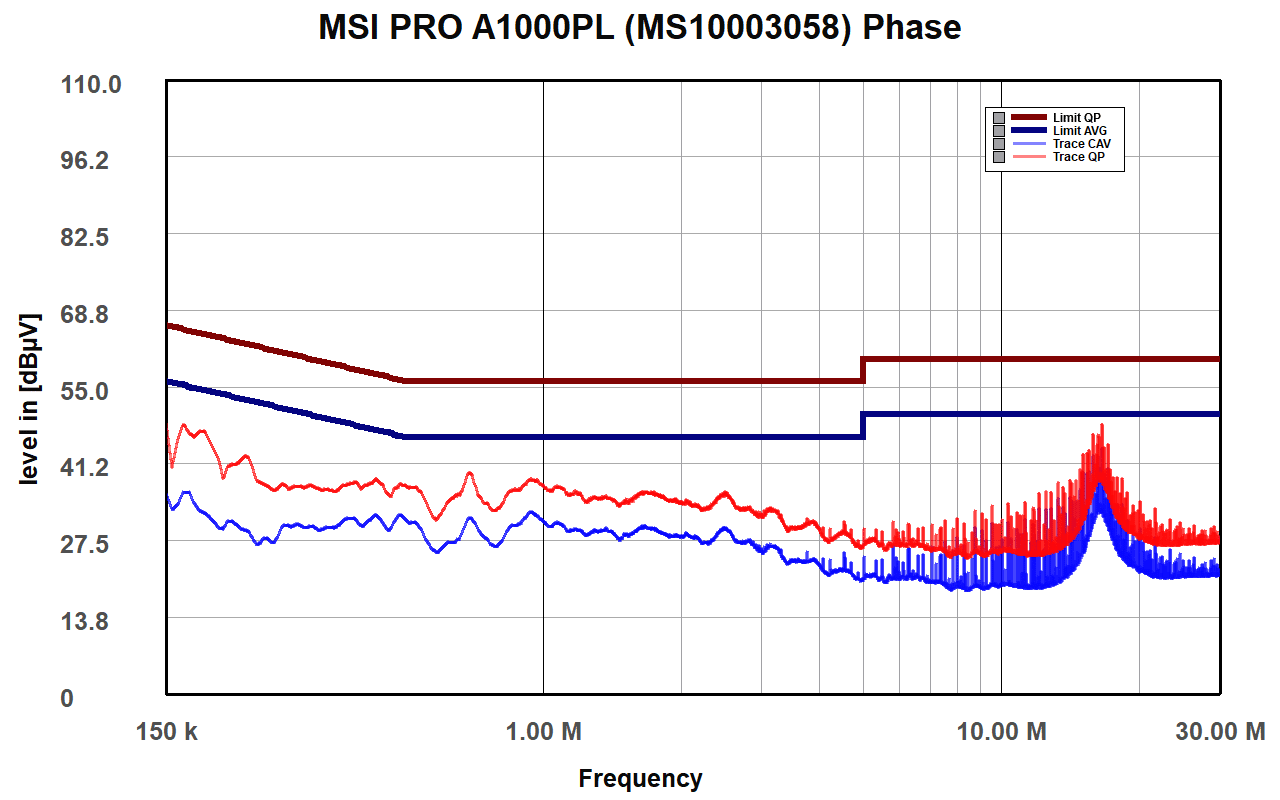 |
The PSU’s EMI emissions are under control.