
Load Regulation
It measures the stability of the output voltage when the load connected to the power supply varies.
| Test | 12V | 5V | 3.3V | 5VSB | DC/AC (Watts) | Efficiency | Fan Speed (RPM) | PSU Noise (dB[A]) | Temps (In/Out) | PF/AC Volts |
| 10% | 6.480A | 1.995A | 2.011A | 0.986A | 100.014 | 89.219% | 0 | <6.0 | 43.99°C | 0.971 |
| 12.101V | 5.012V | 3.283V | 5.074V | 112.1 | 40.13°C | 114.83V | ||||
| 20% | 13.981A | 3A | 3.021A | 1.186A | 199.975 | 91.831% | 0 | <6.0 | 43.55°C | 0.988 |
| 12.093V | 5.001V | 3.277V | 5.062V | 217.764 | 40.79°C | 114.81V | ||||
| 30% | 21.844A | 3.506A | 3.526A | 1.387A | 300.038 | 92.329% | 0 | <6.0 | 44.15°C | 0.993 |
| 12.085V | 4.992V | 3.276V | 5.05V | 324.968 | 41.42°C | 114.78V | ||||
| 40% | 29.691A | 4.019A | 4.036A | 1.589A | 399.681 | 91.997% | 752 | 21 | 41.91°C | 0.995 |
| 12.073V | 4.977V | 3.271V | 5.036V | 434.45 | 49.52°C | 114.73V | ||||
| 50% | 37.209A | 5.034A | 5.038A | 1.793A | 499.394 | 91.551% | 996 | 29.2 | 42.07°C | 0.996 |
| 12.064V | 4.968V | 3.276V | 5.02V | 545.48 | 48.5°C | 114.71V | ||||
| 60% | 44.801A | 6.043A | 6.031A | 1.998A | 599.926 | 90.72% | 1357 | 37.9 | 42.65°C | 0.996 |
| 12.056V | 4.965V | 3.284V | 5.006V | 661.293 | 48.81°C | 114.67V | ||||
| 70% | 52.338A | 7.053A | 7.021A | 2.205A | 699.654 | 90.024% | 1650 | 43.5 | 43.32°C | 0.996 |
| 12.047V | 4.964V | 3.291V | 4.991V | 777.185 | 49.75°C | 114.63V | ||||
| 80% | 59.953A | 8.06A | 8.011A | 2.311A | 799.657 | 89.234% | 1794 | 45.7 | 43.5°C | 0.996 |
| 12.038V | 4.963V | 3.296V | 4.978V | 896.135 | 51.47°C | 114.59V | ||||
| 90% | 67.910A | 8.571A | 8.522A | 2.417A | 899.422 | 88.399% | 1798 | 45.7 | 44.95°C | 0.996 |
| 12.030V | 4.958V | 3.285V | 4.967V | 1017.469 | 54.76°C | 114.54V | ||||
| 100% | 75.679A | 9.089A | 9.07A | 3.034A | 999.413 | 87.505% | 1793 | 45.7 | 45.37°C | 0.996 |
| 12.021V | 4.951V | 3.275V | 4.945V | 1142.119 | 57.2°C | 114.51V | ||||
| 110% | 83.393A | 10.103A | 10.209A | 3.04A | 1099.992 | 86.565% | 1800 | 45.7 | 46.8°C | 0.995 |
| 12.012V | 4.949V | 3.262V | 4.934V | 1270.719 | 61.1°C | 114.46V | ||||
| CL1 | 0.116A | 11.943A | 11.874A | 0A | 101.298 | 84.193% | 663 | 17.8 | 41.59°C | 0.974 |
| 12.098V | 5.041V | 3.343V | 5.083V | 120.319 | 48.12°C | 114.83V | ||||
| CL2 | 0.115A | 19.76A | 0A | 0A | 101.344 | 83.126% | 301 | <6.0 | 41.23°C | 0.974 |
| 12.101V | 5.058V | 3.264V | 5.086V | 121.914 | 49.3°C | 114.84V | ||||
| CL3 | 0.114A | 0A | 19.661A | 0A | 67.383 | 77.397% | 0 | <6.0 | 43.59°C | 0.966 |
| 12.103V | 5.007V | 3.357V | 5.087V | 87.065 | 40.12°C | 114.84V | ||||
| CL4 | 83.187A | 0A | 0A | 0A | 999.934 | 88.344% | 1800 | 45.7 | 45.87°C | 0.996 |
| 12.020V | 4.937V | 3.212V | 5.013V | 1131.862 | 56.19°C | 114.52V |
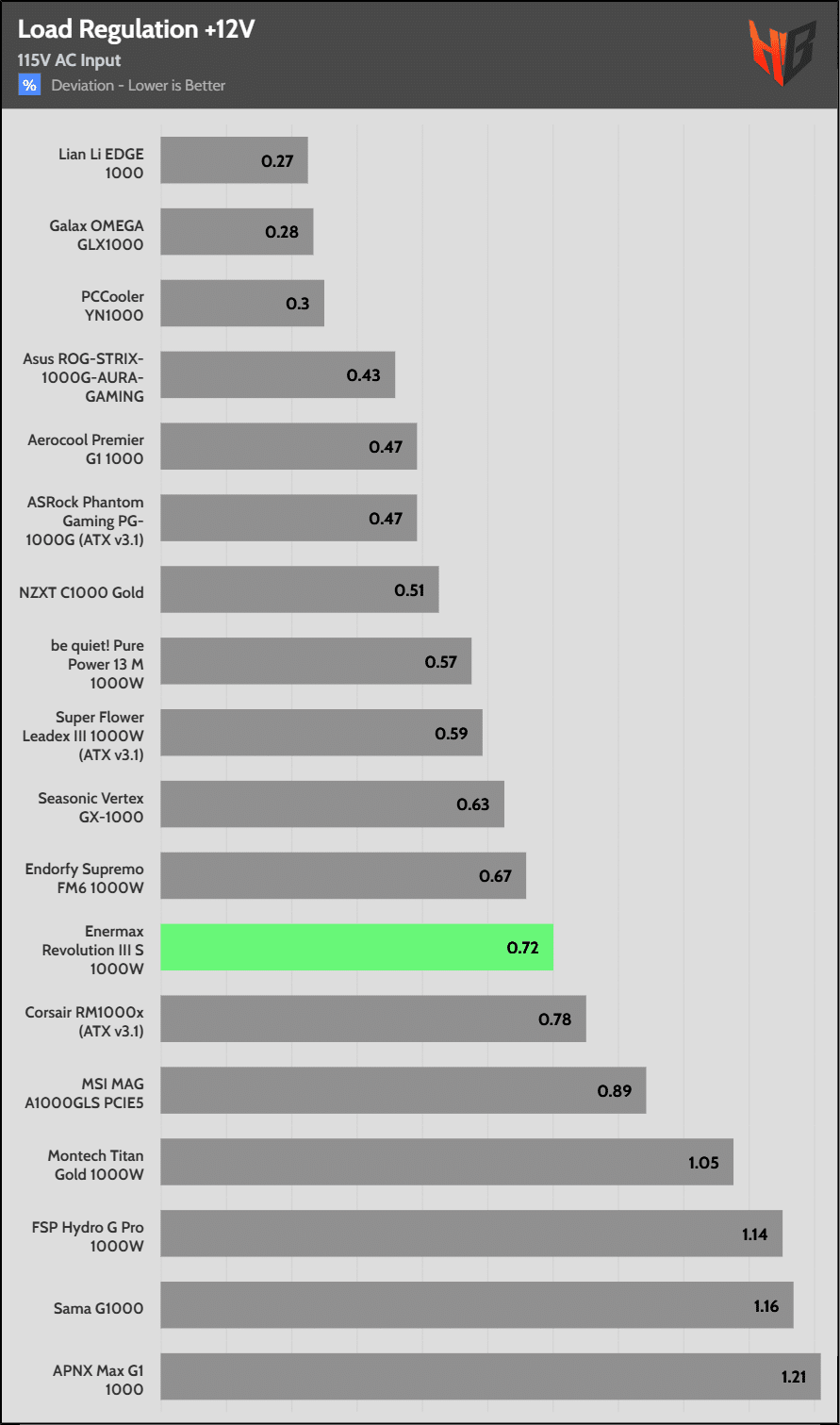
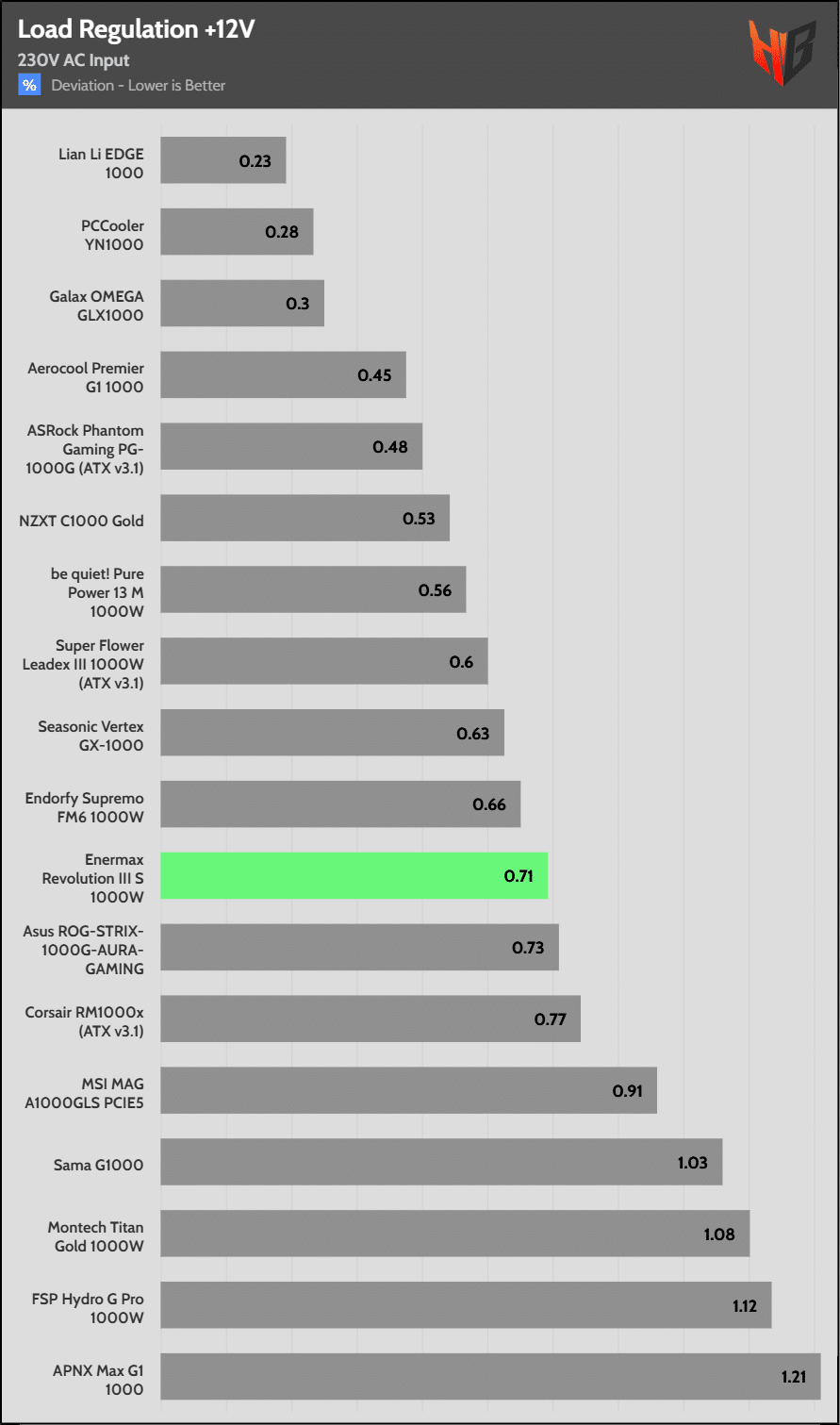
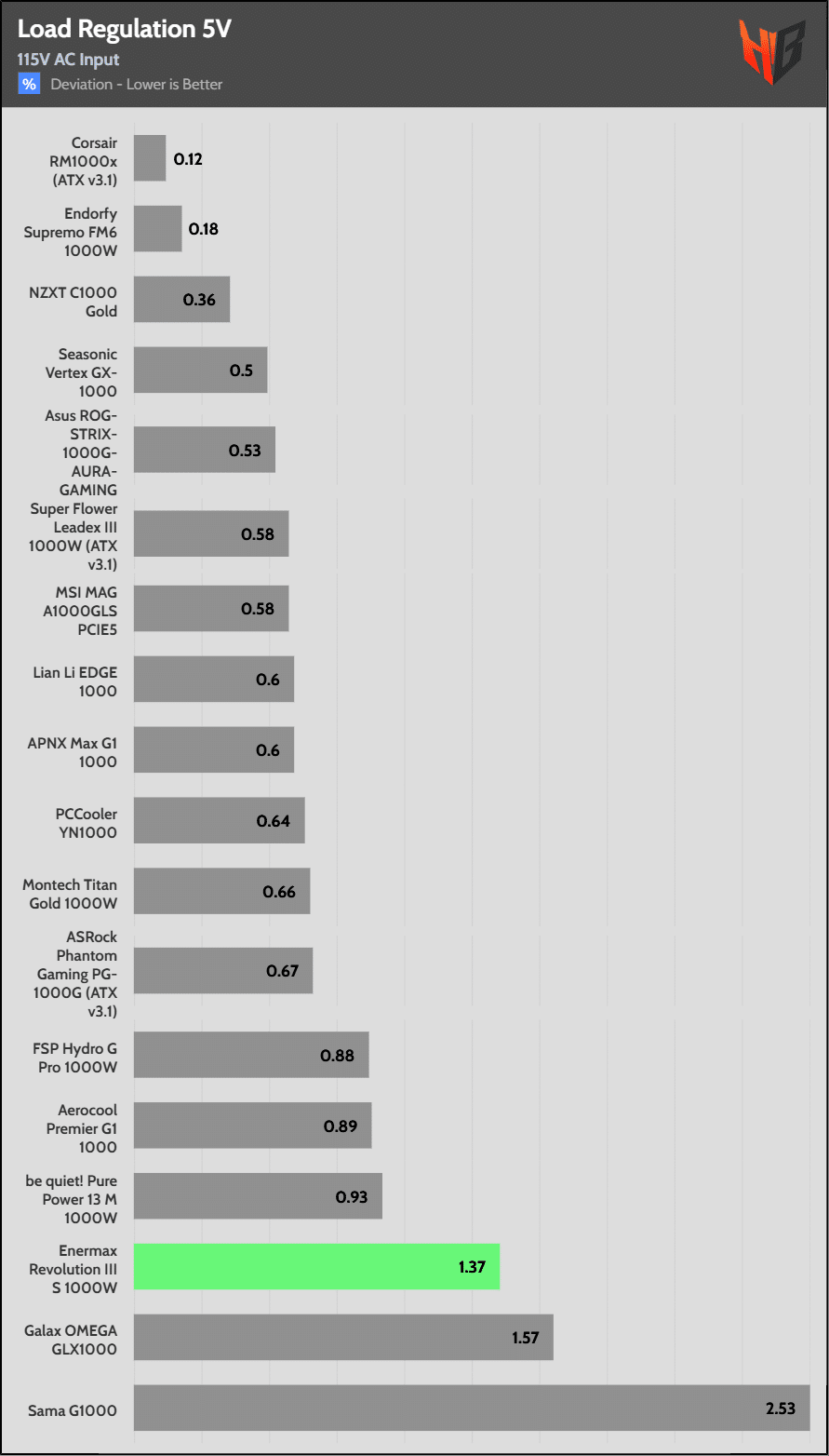
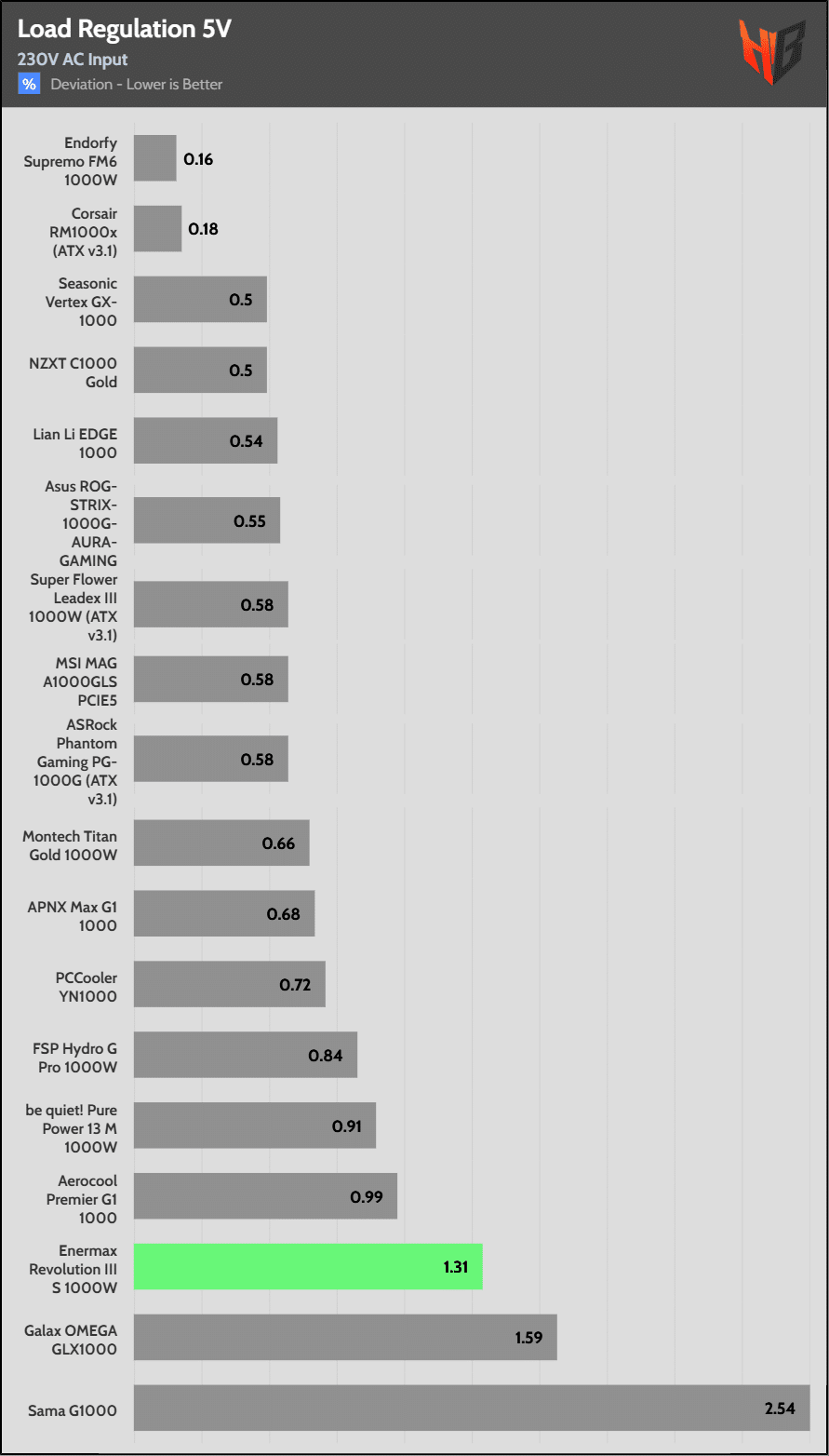
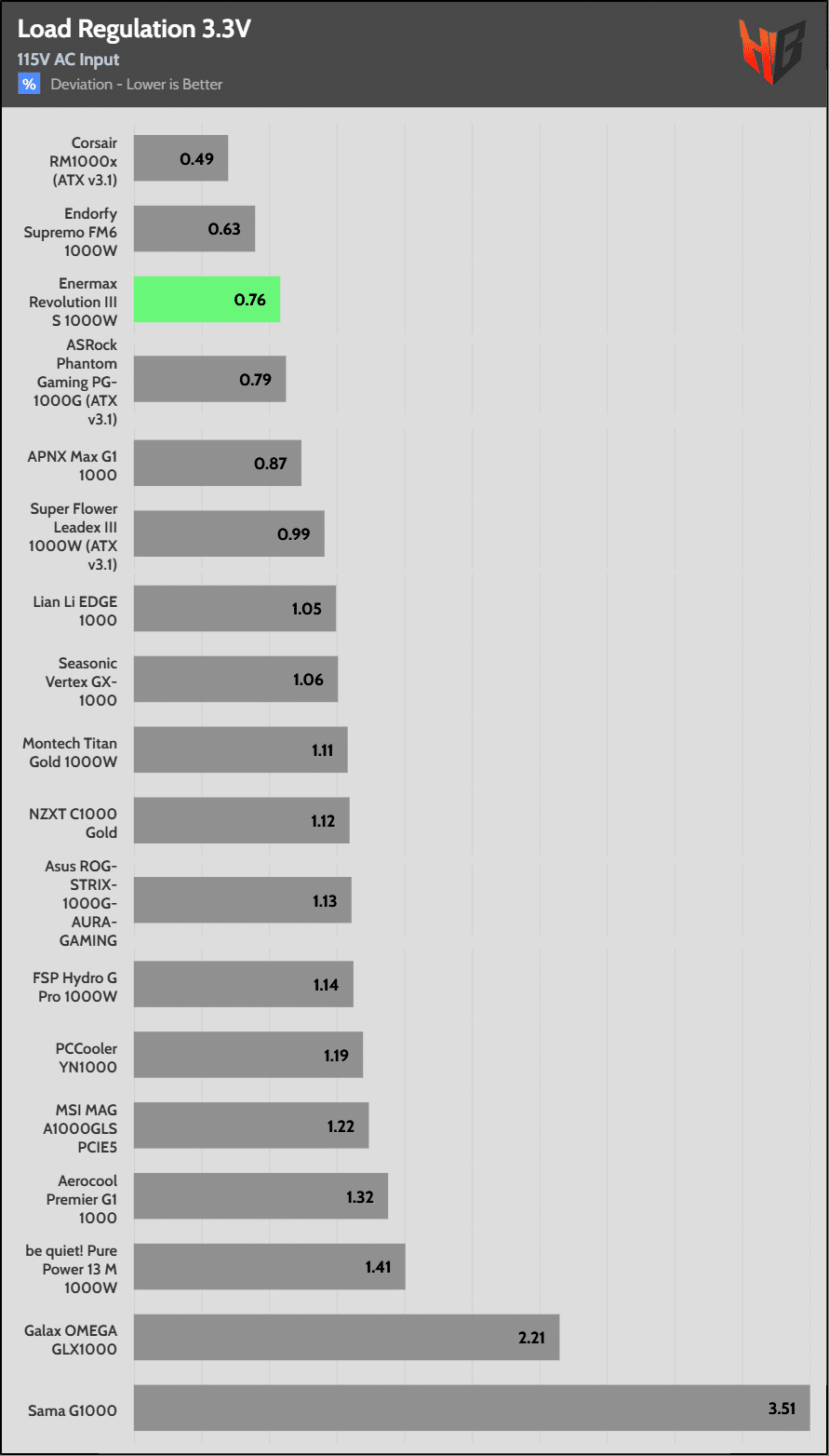
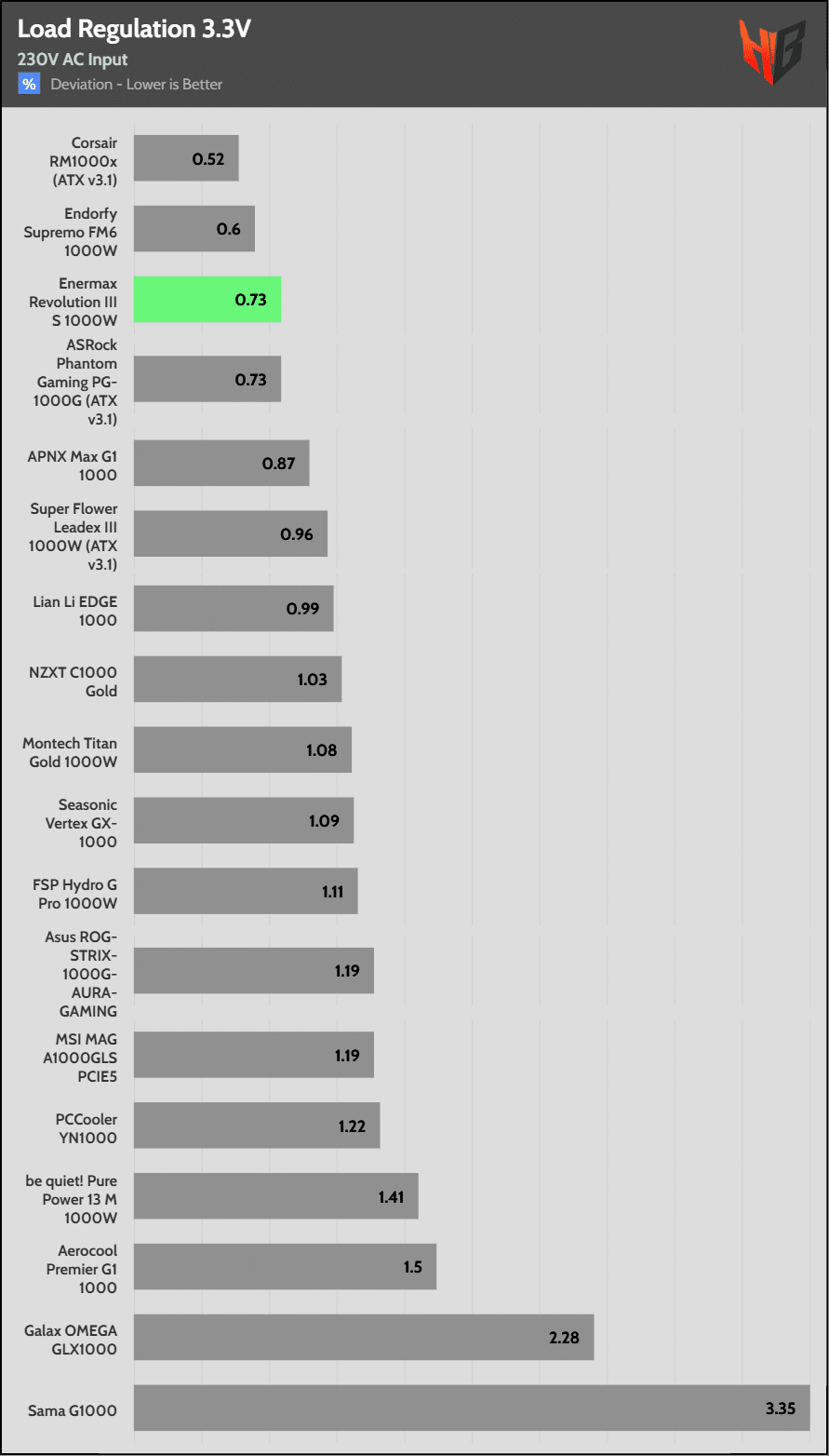
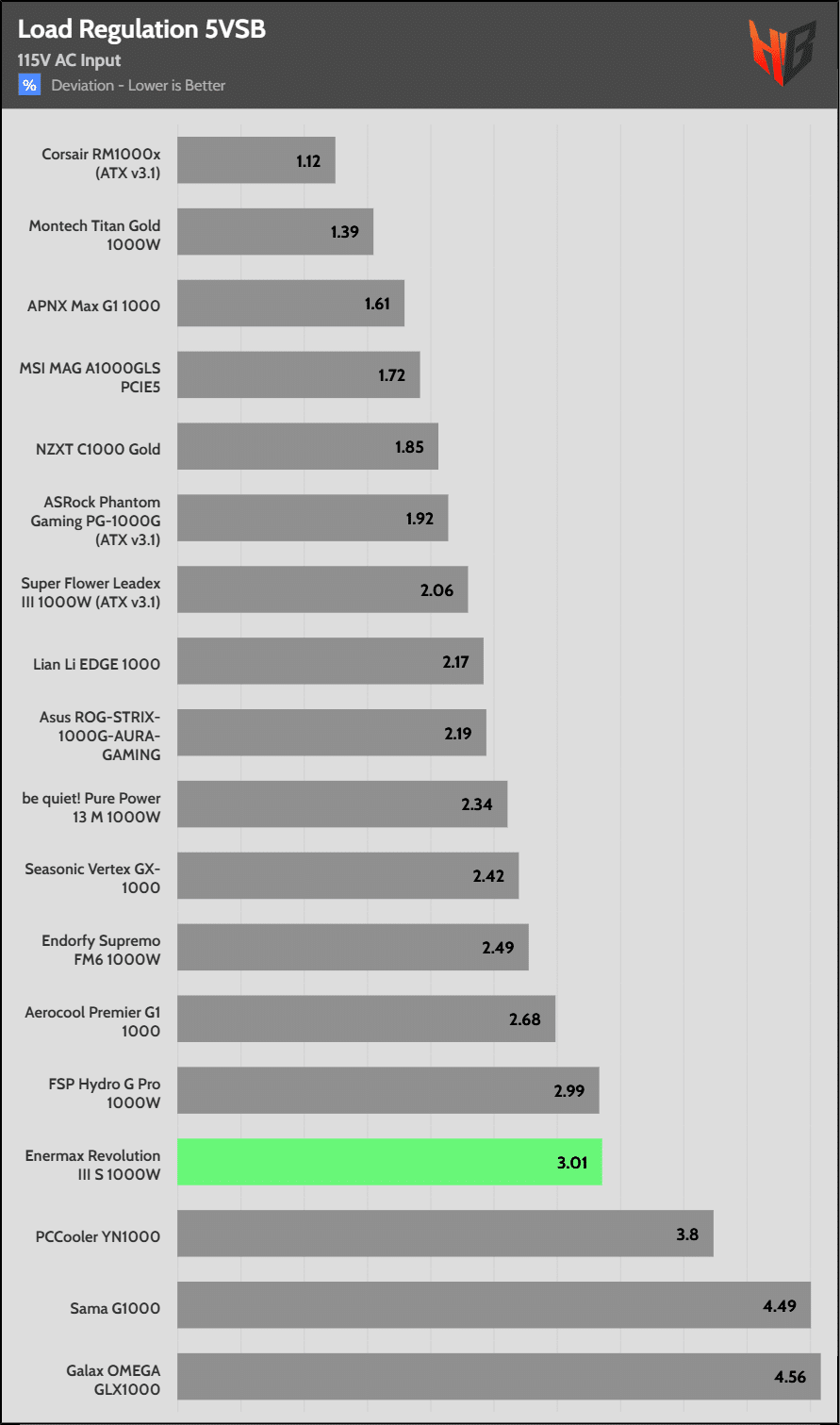
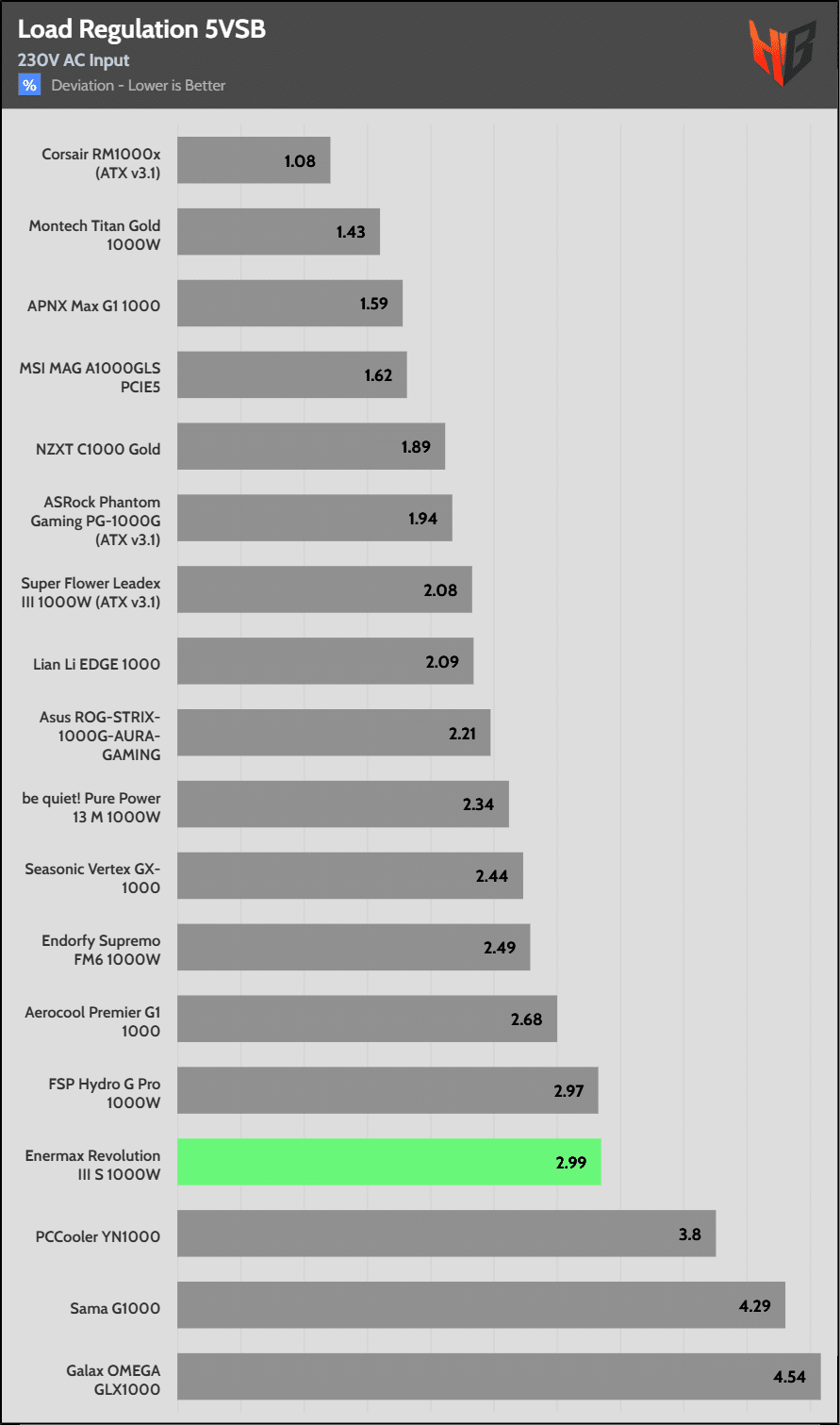
Load regulation is within 1% at 12V and 3.3V. It is pretty loose at 5V.
| Test | 12V | 5V | 3.3V | 5VSB | DC/AC (Watts) | Efficiency | Fan Speed (RPM) | PSU Noise (dB[A]) | Temps (In/Out) | PF/AC Volts |
| 20W | 1.227A | 0.498A | 0.501A | 0.196A | 20.005 | 75.482% | 0 | <6.0 | 41.58°C | 0.811 |
| 12.107V | 5.019V | 3.292V | 5.094V | 26.503 | 36.74°C | 114.87V | ||||
| 40W | 2.700A | 0.698A | 0.702A | 0.295A | 40.006 | 84.38% | 0 | <6.0 | 41.59°C | 0.917 |
| 12.106V | 5.017V | 3.29V | 5.091V | 47.41 | 37.38°C | 114.86V | ||||
| 60W | 4.175A | 0.897A | 0.903A | 0.393A | 60.006 | 87.714% | 0 | <6.0 | 42.47°C | 0.956 |
| 12.104V | 5.016V | 3.288V | 5.088V | 68.412 | 38.69°C | 114.84V | ||||
| 80W | 5.646A | 1.097A | 1.105A | 0.492A | 79.959 | 88.736% | 0 | <6.0 | 42.87°C | 0.966 |
| 12.102V | 5.014V | 3.286V | 5.085V | 90.108 | 39.44°C | 114.84V |
A glance at the light-load table is always useful, as the PSU typically operates at light loads.
Ripple Suppression
Ripple in power supplies refers to the small, unwanted AC voltage fluctuations superimposed on the DC output. It occurs due to imperfect filtering during the AC-to-DC conversion. Lower ripple is highly preferable because it ensures a cleaner, more stable DC output, reducing noise and potential interference in sensitive electronics, improving performance, and extending component lifespan. High ripple can cause instability, overheating, or damage to connected devices.
| Test | 12V | 5V | 3.3V | 5VSB | Pass/Fail |
| 10% Load | 28.4 mV | 19.8 mV | 19.3 mV | 16.8 mV | Pass |
| 20% Load | 31.6 mV | 20.4 mV | 19.6 mV | 17.1 mV | Pass |
| 30% Load | 34.6 mV | 21.4 mV | 21.6 mV | 17.2 mV | Pass |
| 40% Load | 35.5 mV | 21.8 mV | 21.1 mV | 17.7 mV | Pass |
| 50% Load | 36.9 mV | 23.5 mV | 22.3 mV | 18.8 mV | Pass |
| 60% Load | 37.3 mV | 22.6 mV | 22.3 mV | 18.9 mV | Pass |
| 70% Load | 39.1 mV | 23.7 mV | 21.6 mV | 19.6 mV | Pass |
| 80% Load | 39.8 mV | 23.5 mV | 22.6 mV | 21.7 mV | Pass |
| 90% Load | 41.4 mV | 25.8 mV | 25.0 mV | 21.0 mV | Pass |
| 100% Load | 45.4 mV | 24.6 mV | 24.2 mV | 20.3 mV | Pass |
| 110% Load | 47.1 mV | 25.1 mV | 25.3 mV | 19.7 mV | Pass |
| Crossload 1 | 25.6 mV | 16.8 mV | 17.1 mV | 18.0 mV | Pass |
| Crossload 2 | 28.9 mV | 22.3 mV | 19.1 mV | 18.1 mV | Pass |
| Crossload 3 | 33.2 mV | 19.8 mV | 20.7 mV | 18.0 mV | Pass |
| Crossload 4 | 42.0 mV | 21.4 mV | 19.1 mV | 19.5 mV | Pass |
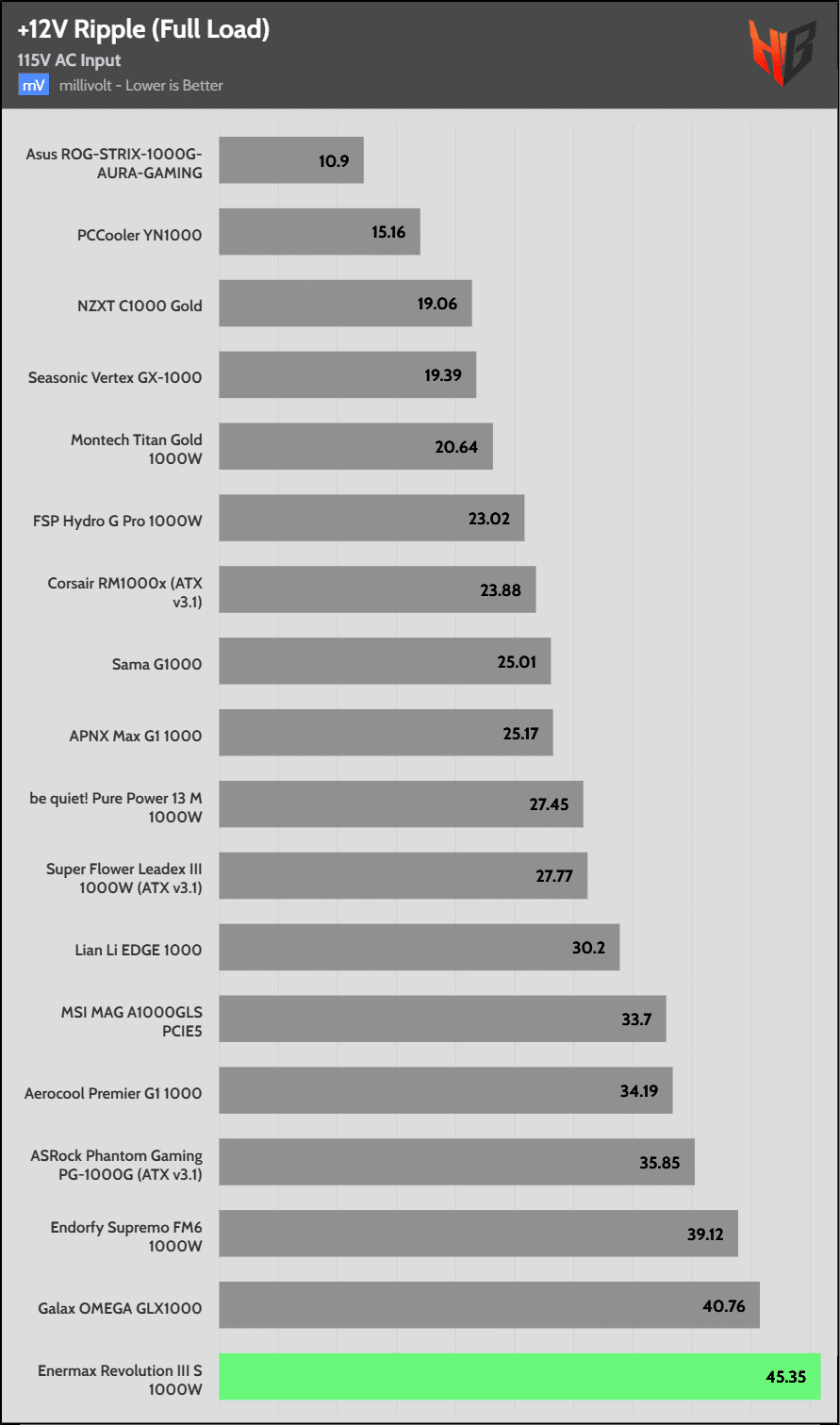
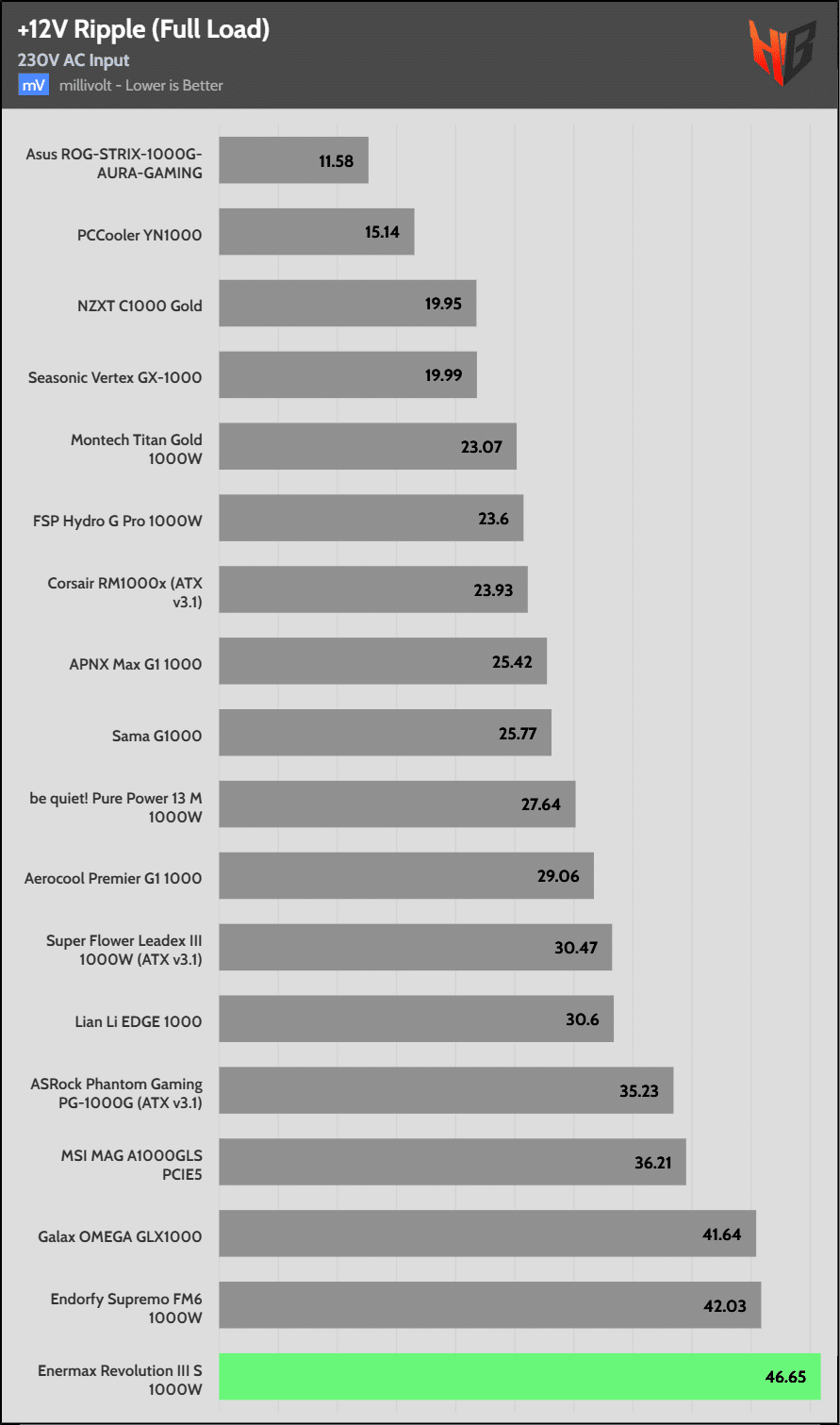
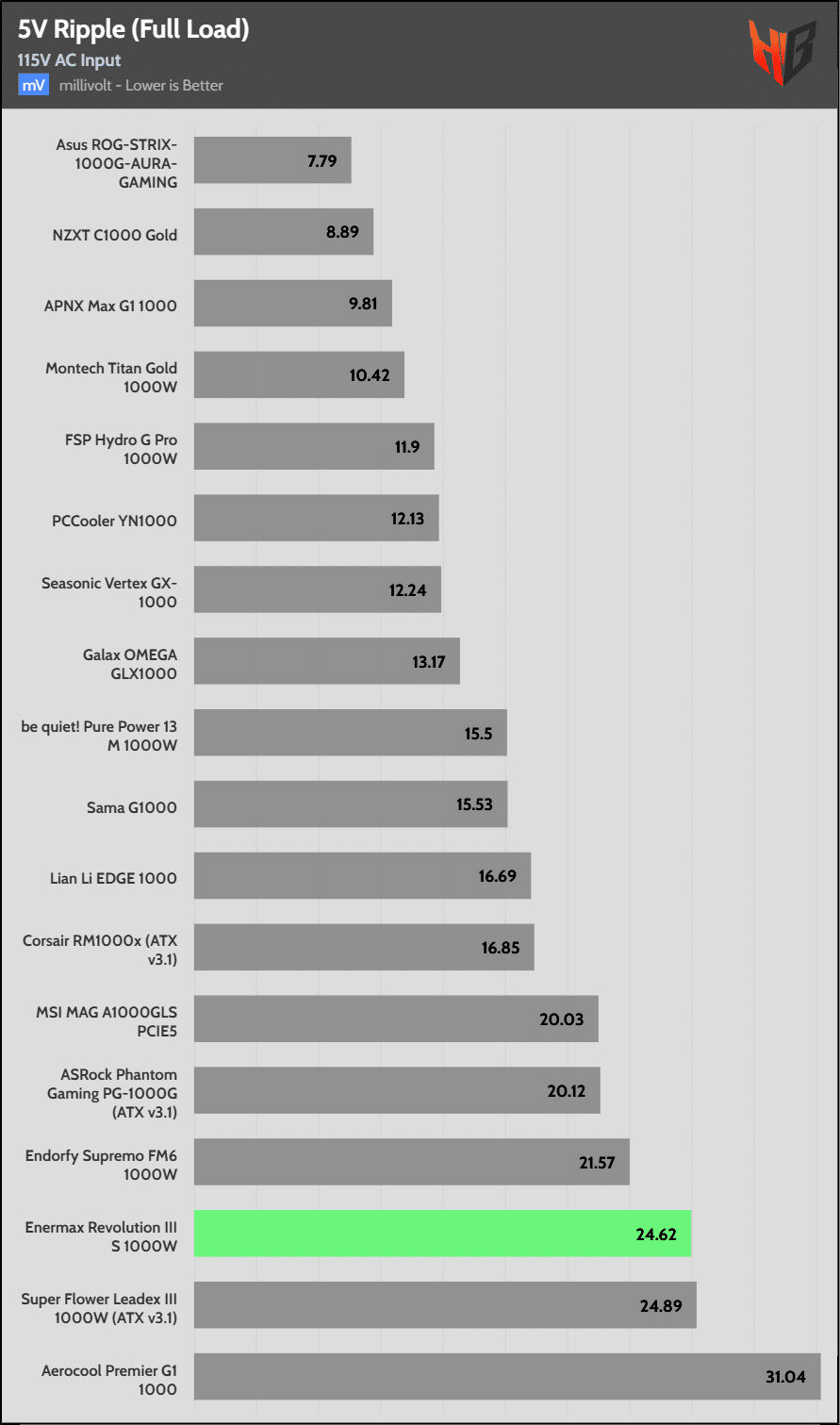
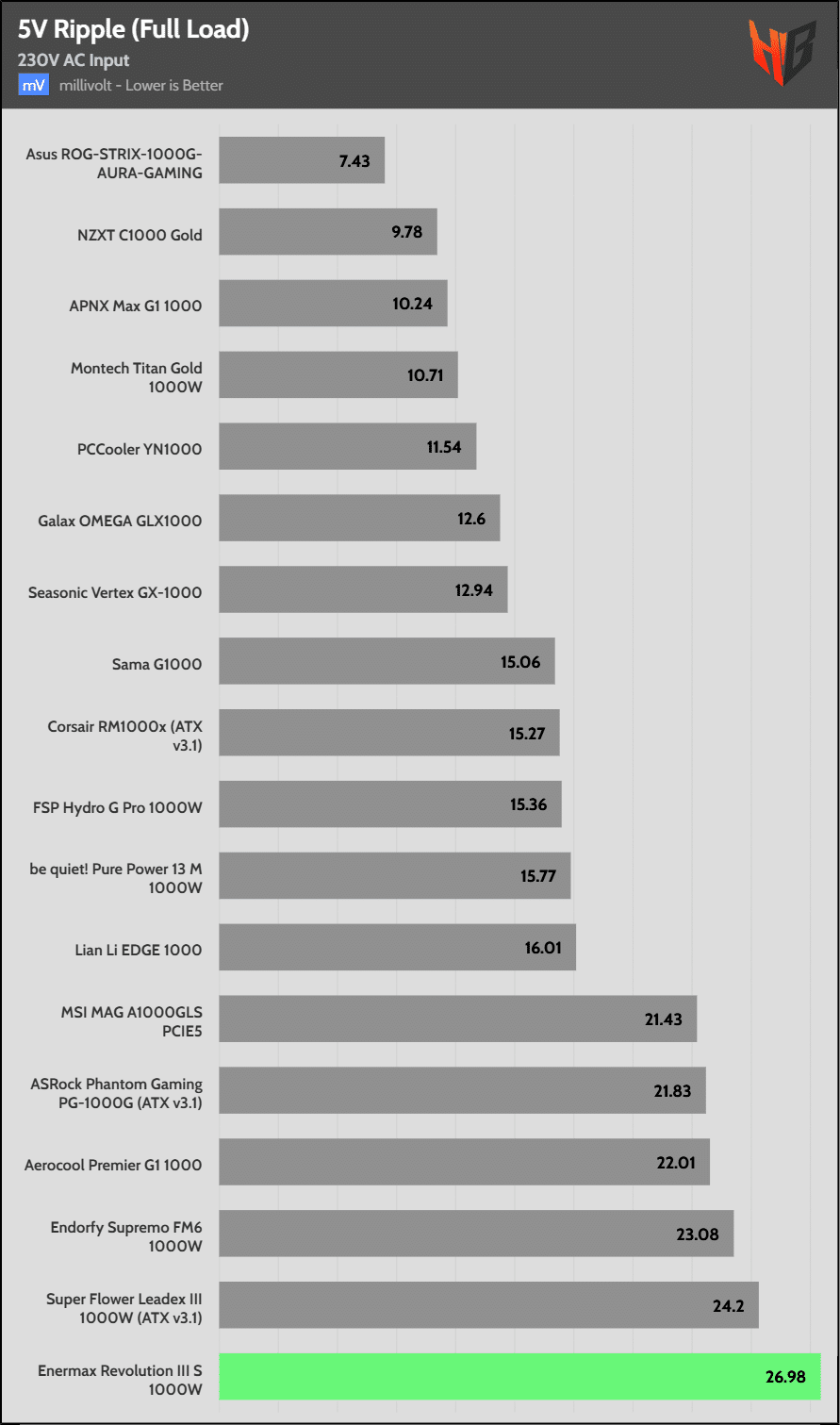
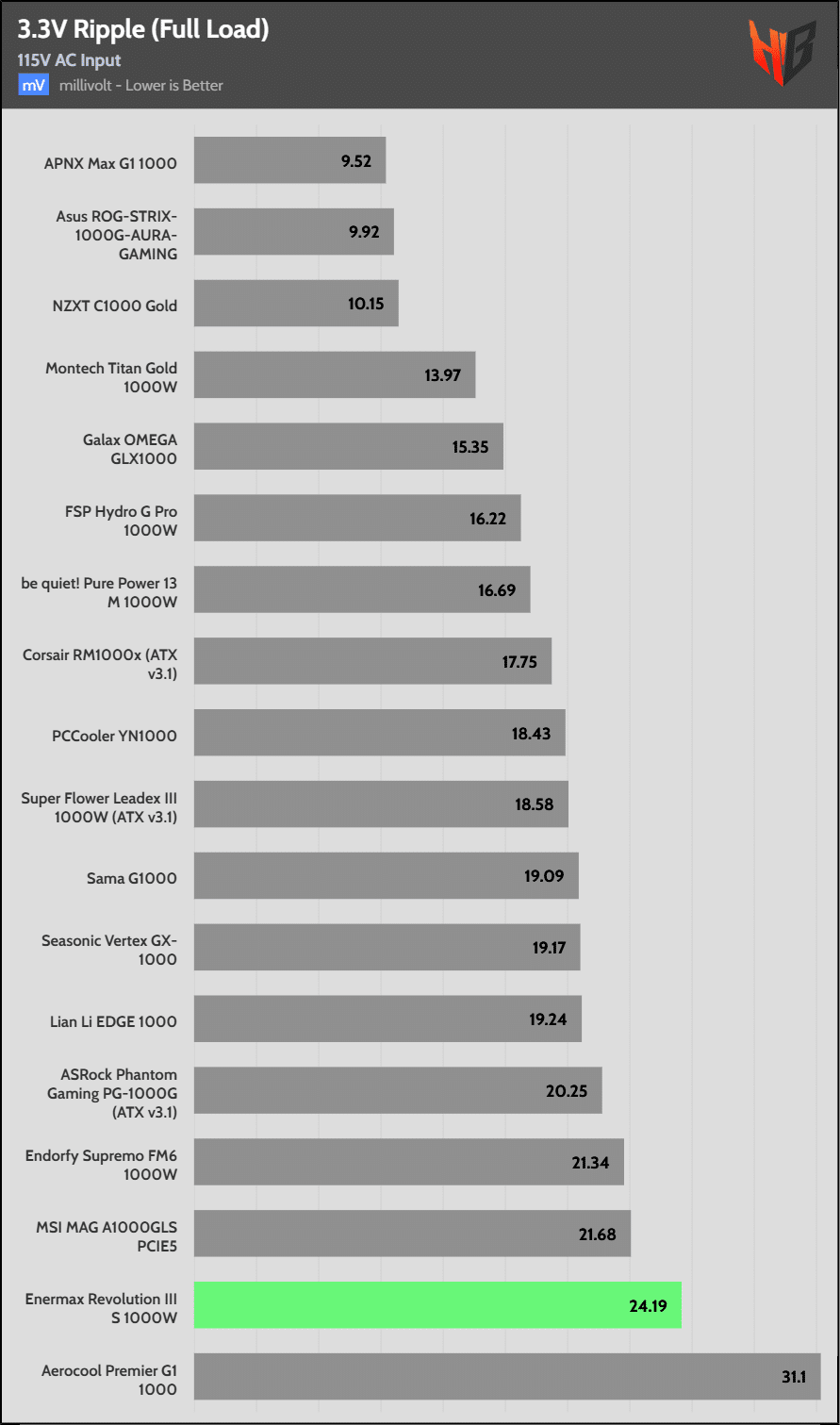
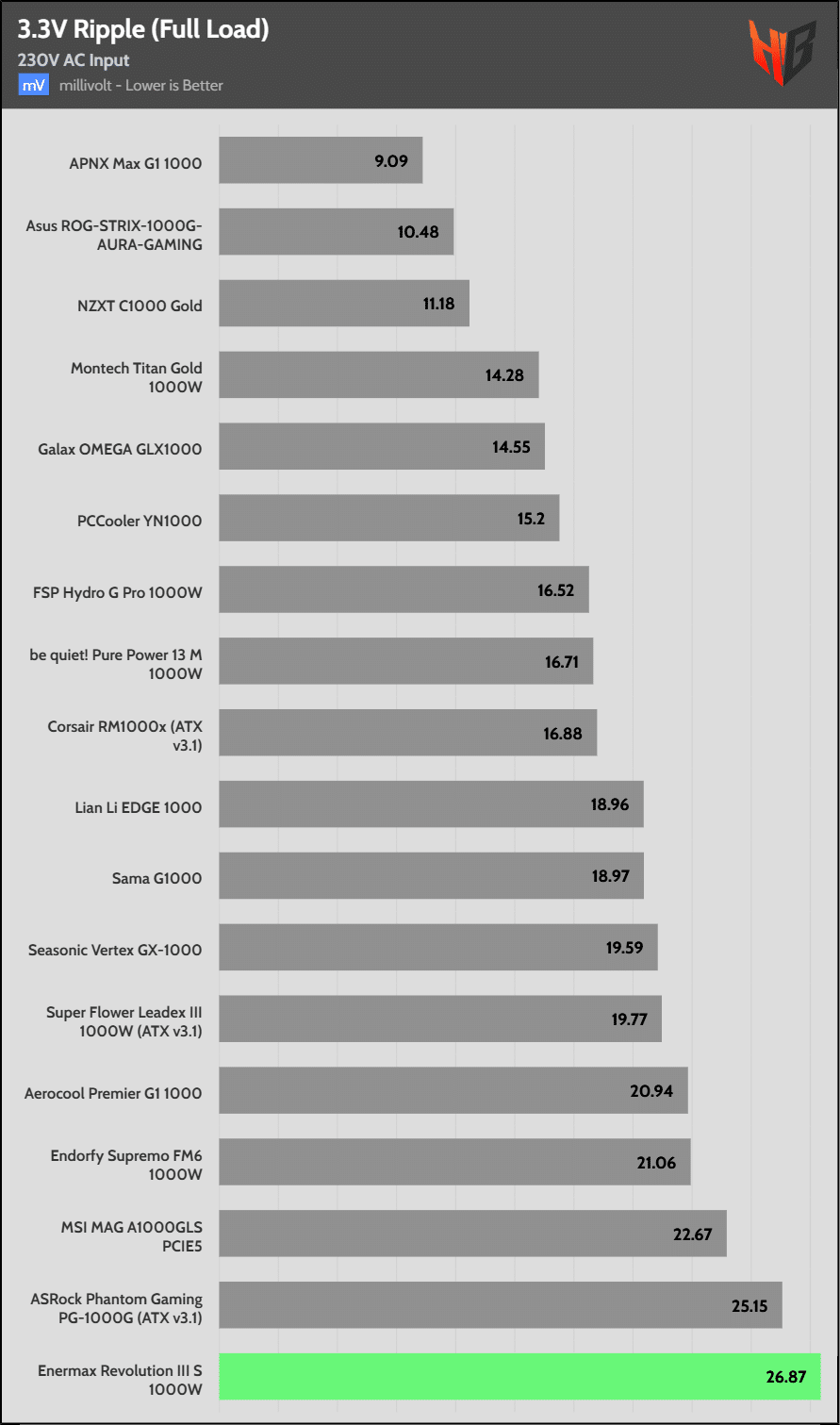

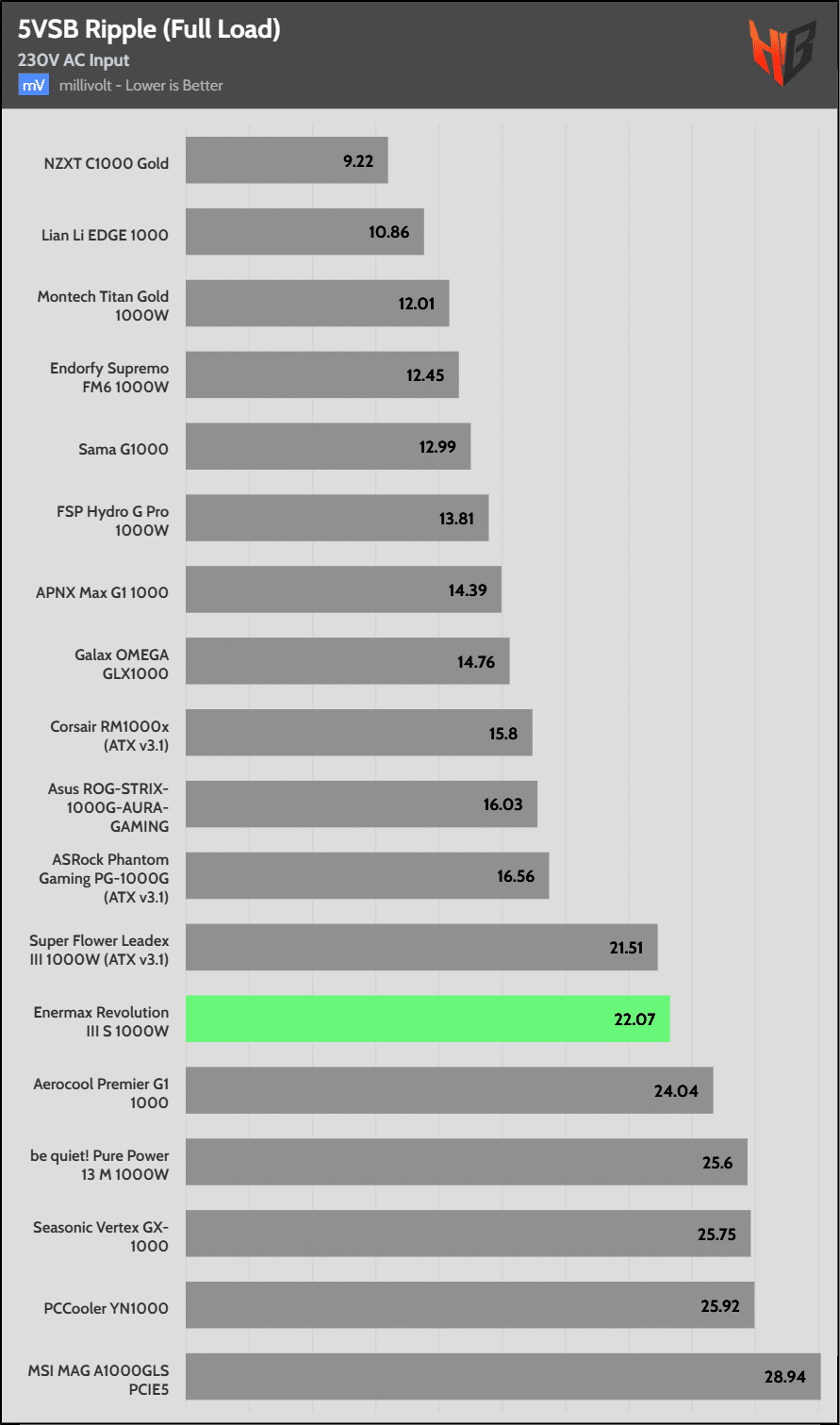
Ripple suppression is not competitive, especially at 12V, which is the most important rail.
The Cybenetics report indicates that this power supply is compliant with ATX 3.1; however, the transient testing results show issues on the 3.3 V rail.
Could you clarify how ATX 3.1 pass/fail determinations are defined in your methodology? Specifically, how are transient deviations on secondary rails, such as the 3.3 V rail, evaluated when concluding overall ATX 3.1 compliance?
Reference:
Cybenetics ATX 3.1 PASS Report
https://www.cybenetics.com/evaluations/psus/2971/
Which transient response results are you referring to? The transient response tests with normal loads, which I do, and without capacitors? These are my tests; they are not included in any ATX spec. I have been conducting these for many years now, and they are there to compare all PSUs with load on all rails directly.
The ATX v3.1 uses an entirely different transient response load scheme, which Cybenetics adopts, to check against this standard.
This standard is open, so you can study it and look at what it says about transient report testing.
based on your experience did unicon caps was better than toshin kogyo or similar with nippon chemicon, rubycon or nichicon ?
I don’t think they are better than the well-known caps, especially the last three brands you mention.
so it’s basically same tier as TK ?
I don’t have a clue unless I check enough capacitors from Unicon and TK
but did it basically same as TK, japan caps made in chinese factory ?
Interestingly, SAMA P uses a different RSY platform and shows excellent results.
Hi, Aris, do you have any idea why BeQuiet lists Cybenetics Gold efficiency and Noise A+ in its marketing materials, when all Pure Power 13 M PSUs achieved Platinum and A++?
Did they change anything after your tests or why?
They can always downgrade the badges, but never upgrade them.
…they certainly can, but what’s the point, from a marketing point of view,
…probably none.
Maybe they’re not sure about the manufacturing tolerances, who knows 👀