Load Regulation
It measures the stability of the output voltage when the load connected to the power supply varies.
| Test | 12V | 5V | 3.3V | 5VSB | DC/AC (Watts) | Efficiency | Fan Speed (RPM) | PSU Noise (dB[A]) | Temps (In/Out) | PF/AC Volts |
| 10% | 4.466A | 2.012A | 1.994A | 0.99A | 75.009 | 85.703% | 0 | <6.0 | 44.26°C | 0.96 |
| 11.960V | 4.971V | 3.31V | 5.051V | 87.517 | 40.15°C | 114.93V | ||||
| 20% | 9.963A | 3.019A | 2.992A | 1.19A | 149.975 | 87.996% | 0 | <6.0 | 45.37°C | 0.979 |
| 11.951V | 4.97V | 3.309V | 5.044V | 170.434 | 40.51°C | 114.92V | ||||
| 30% | 15.819A | 3.523A | 3.492A | 1.39A | 224.984 | 92.058% | 0 | <6.0 | 47.58°C | 0.985 |
| 11.943V | 4.969V | 3.308V | 5.038V | 244.379 | 41.21°C | 114.91V | ||||
| 40% | 21.688A | 4.027A | 3.992A | 1.59A | 300.08 | 92.113% | 0 | <6.0 | 48.81°C | 0.989 |
| 11.937V | 4.968V | 3.307V | 5.031V | 325.791 | 41.71°C | 114.89V | ||||
| 50% | 27.182A | 5.035A | 4.991A | 1.792A | 374.749 | 91.647% | 0 | <6.0 | 48.74°C | 0.992 |
| 11.928V | 4.966V | 3.306V | 5.025V | 408.929 | 42.17°C | 114.87V | ||||
| 60% | 32.701A | 6.045A | 5.993A | 1.993A | 449.678 | 91.014% | 414 | <6.0 | 42.73°C | 0.995 |
| 11.922V | 4.965V | 3.305V | 5.018V | 494.076 | 62.94°C | 114.86V | ||||
| 70% | 38.230A | 7.055A | 6.995A | 2.196A | 524.608 | 90.411% | 451 | <6.0 | 43.33°C | 0.996 |
| 11.914V | 4.963V | 3.303V | 5.011V | 580.264 | 64.52°C | 114.84V | ||||
| 80% | 43.831A | 8.065A | 7.997A | 2.298A | 599.829 | 89.479% | 695 | 19.4 | 43.99°C | 0.997 |
| 11.908V | 4.961V | 3.301V | 5.005V | 670.329 | 61.86°C | 114.83V | ||||
| 90% | 49.773A | 8.571A | 8.485A | 2.4A | 674.868 | 88.745% | 880 | 27.6 | 44.06°C | 0.997 |
| 11.902V | 4.959V | 3.3V | 5V | 760.42 | 61.36°C | 114.81V | ||||
| 100% | 55.521A | 9.078A | 9.004A | 3.007A | 750.087 | 87.893% | 1078 | 33.1 | 45.01°C | 0.998 |
| 11.894V | 4.958V | 3.299V | 4.989V | 853.429 | 61.97°C | 114.79V | ||||
| 110% | 61.142A | 10.09A | 10.1A | 3.01A | 825.102 | 86.9% | 1296 | 38.8 | 46.23°C | 0.998 |
| 11.887V | 4.956V | 3.297V | 4.985V | 949.444 | 62.03°C | 114.77V | ||||
| CL1 | 0.118A | 14.558A | 14.44A | 0A | 121.312 | 81.541% | 501 | 7.2 | 40.75°C | 0.974 |
| 11.940V | 4.96V | 3.303V | 5.051V | 148.393 | 54.4°C | 114.57V | ||||
| CL2 | 0.117A | 20.159A | 0A | 0A | 101.404 | 80.142% | 1083 | 33.3 | 40.66°C | 0.972 |
| 11.951V | 4.961V | 3.314V | 5.057V | 126.521 | 47.87°C | 114.93V | ||||
| CL3 | 0.117A | 0A | 19.998A | 0A | 67.399 | 75.852% | 730 | 21.3 | 40.11°C | 0.96 |
| 11.956V | 4.97V | 3.3V | 5.056V | 88.815 | 46.9°C | 114.93V | ||||
| CL4 | 62.985A | 0A | 0A | 0A | 749.88 | 88.772% | 982 | 30.7 | 45.05°C | 0.998 |
| 11.906V | 4.967V | 3.306V | 5.03V | 844.737 | 59.63°C | 114.77V |
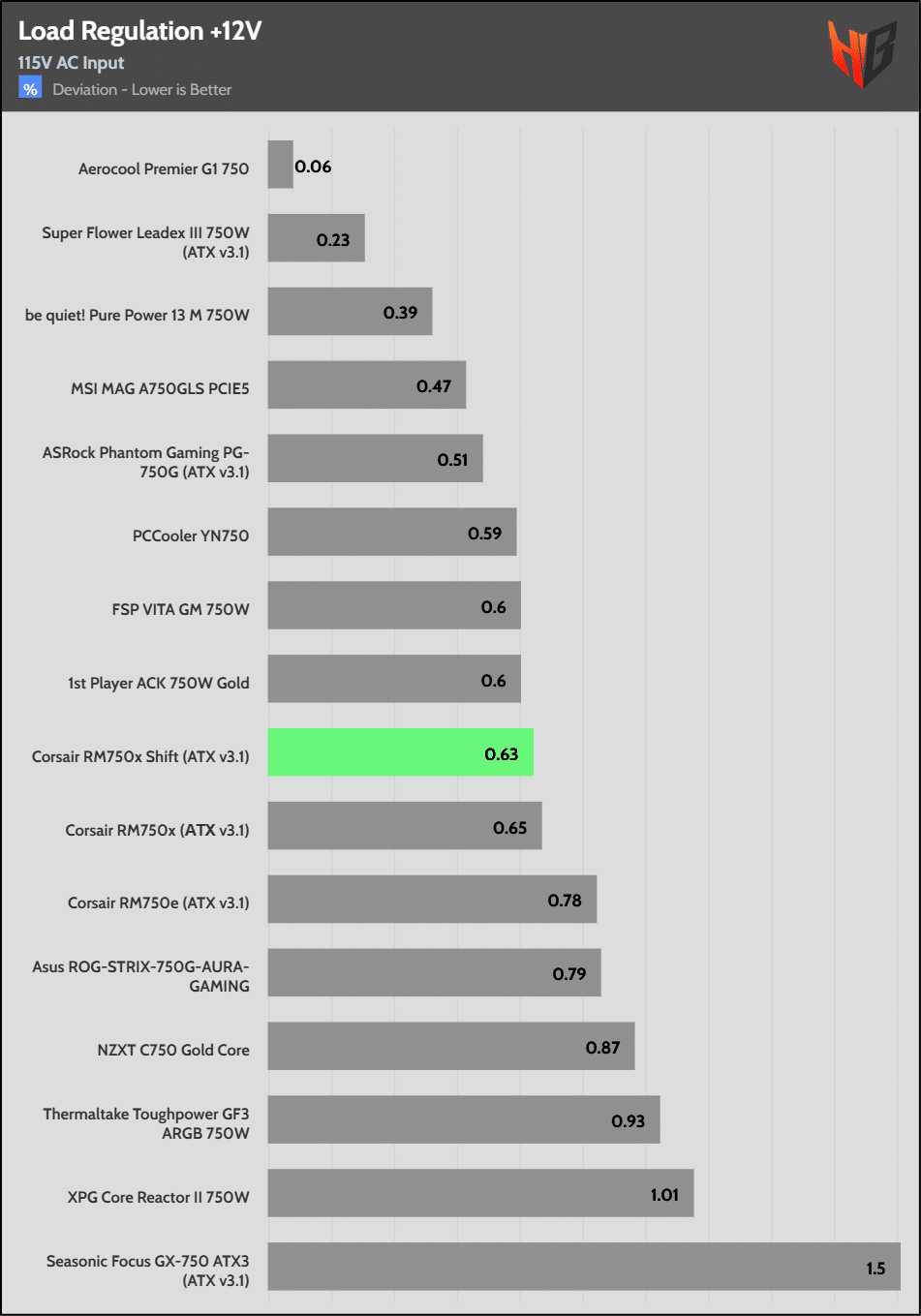
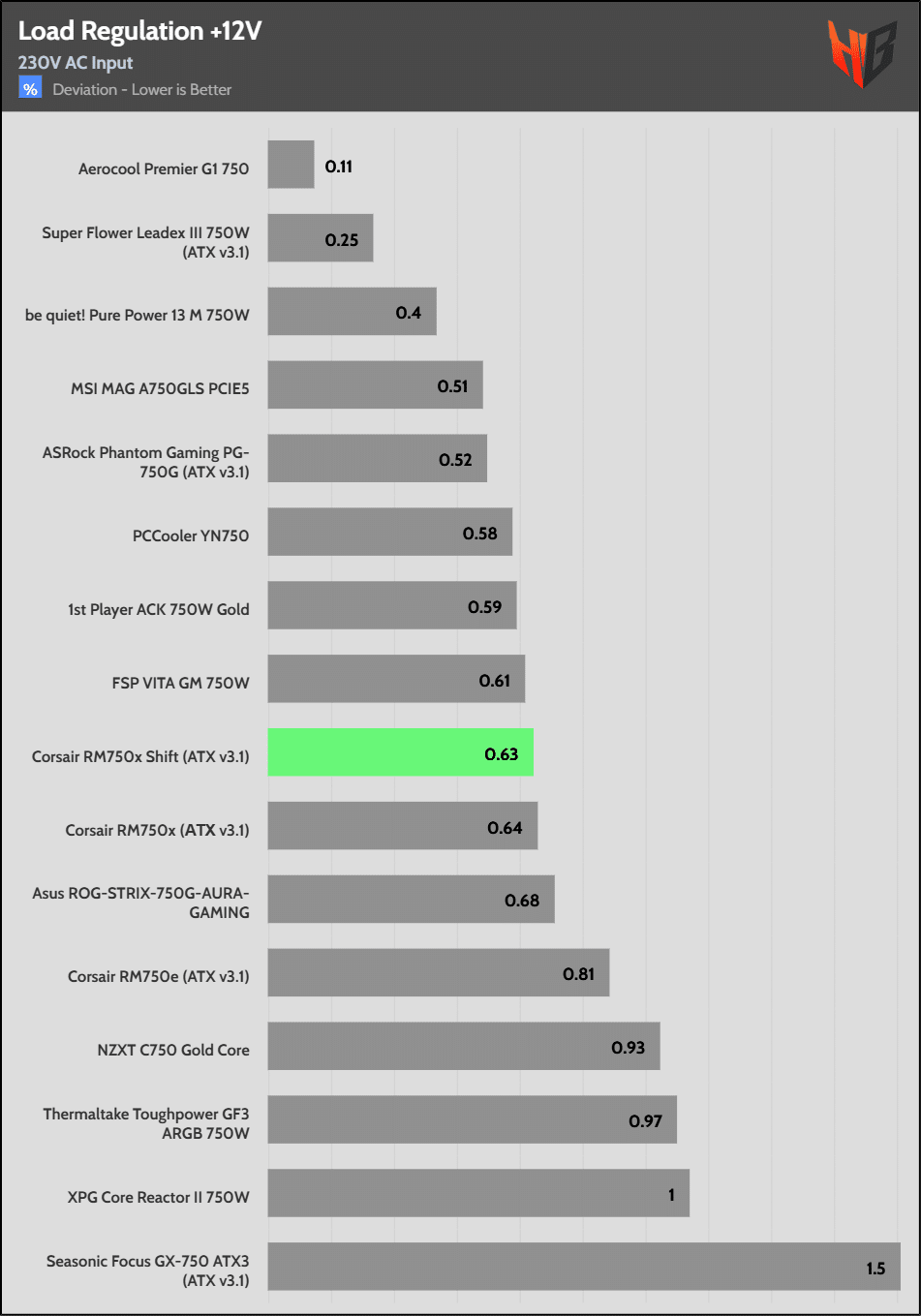
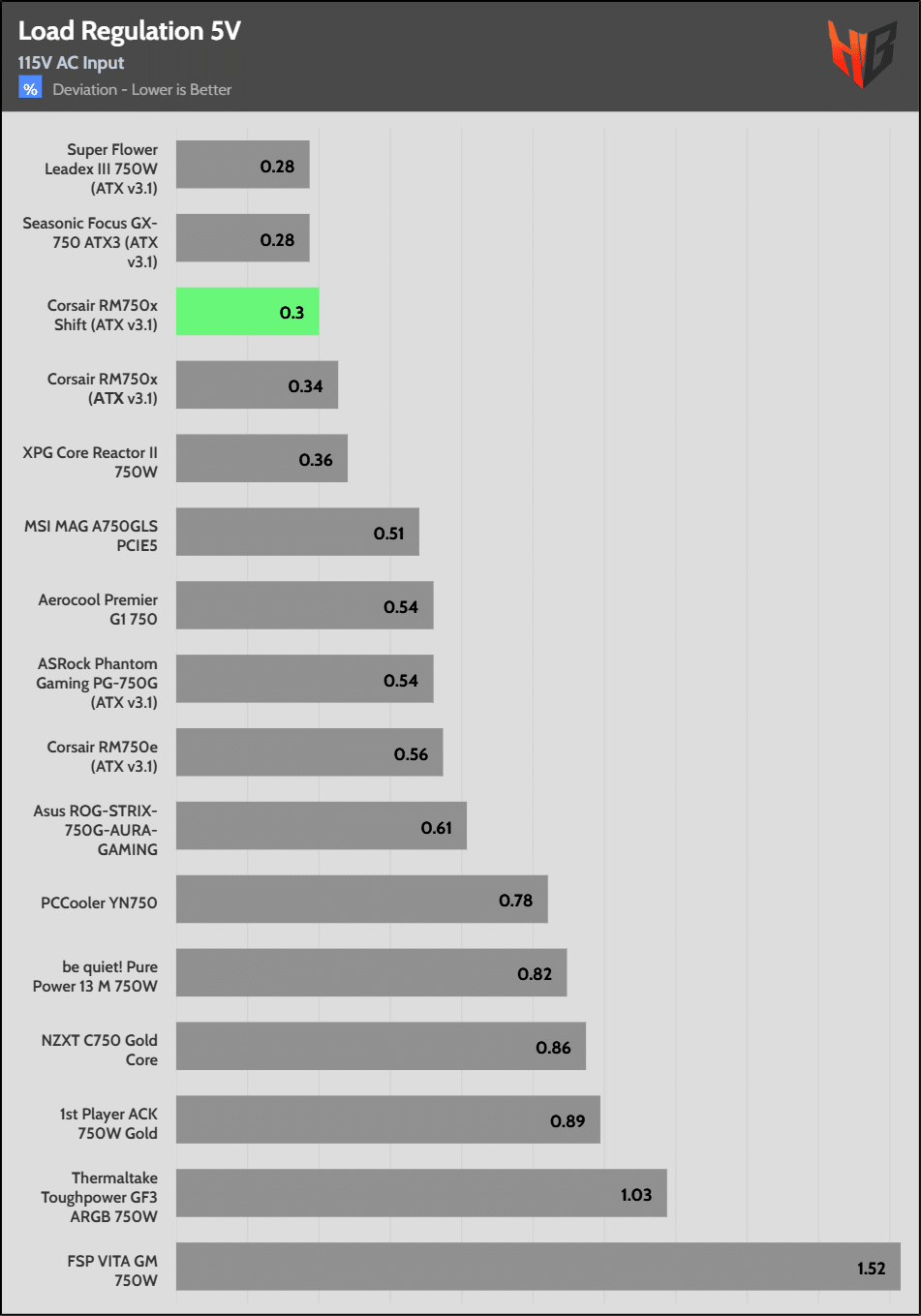
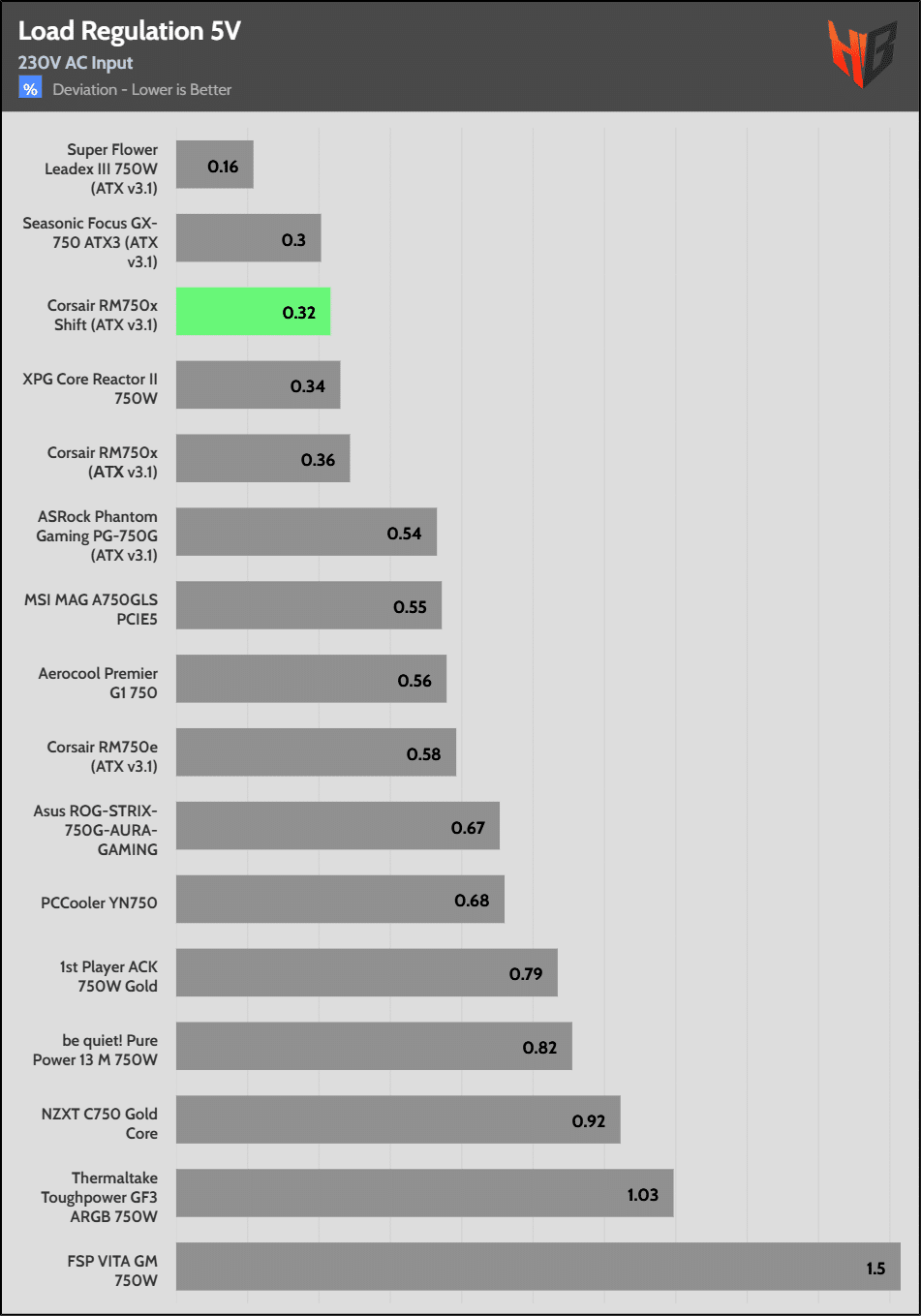
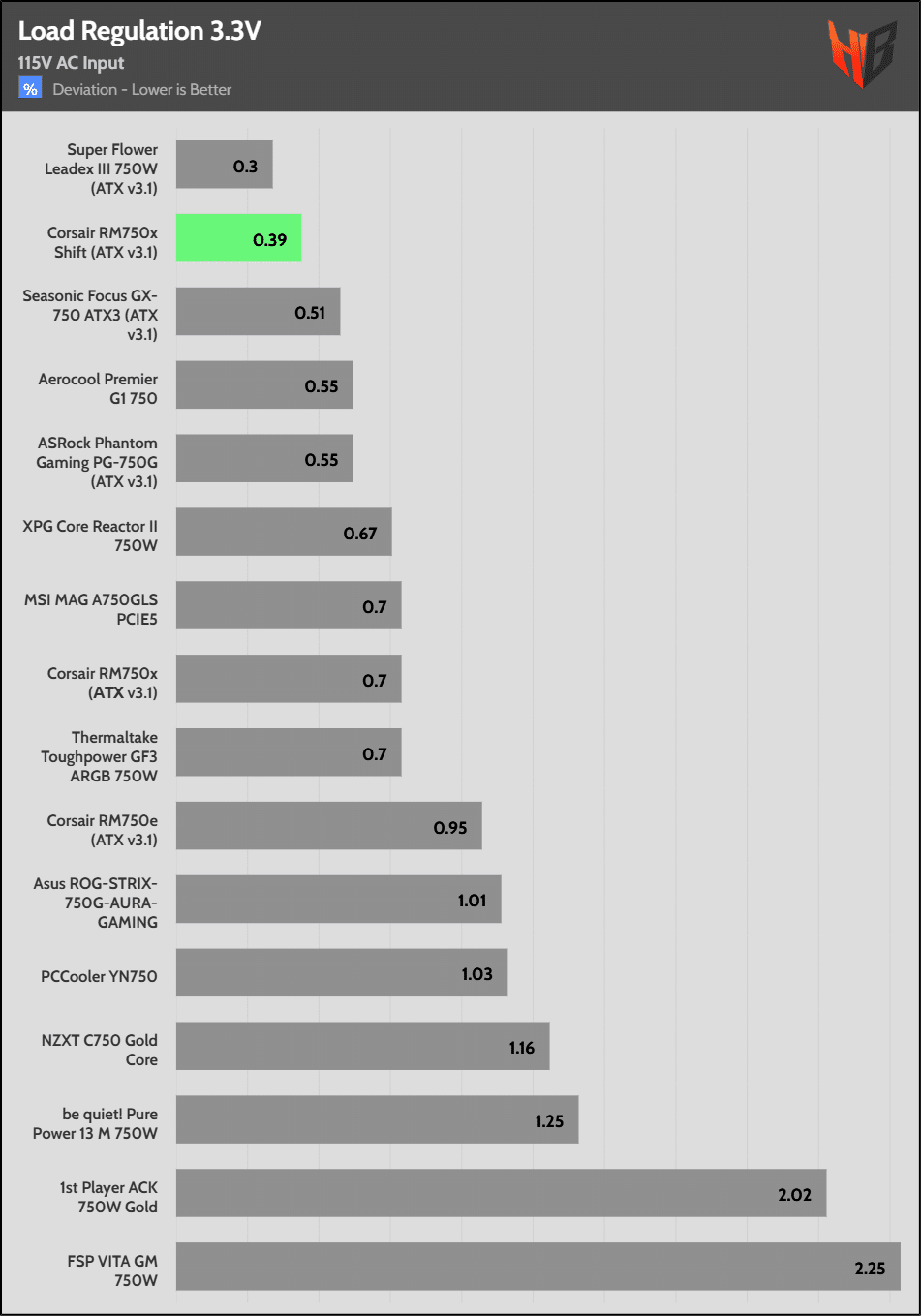
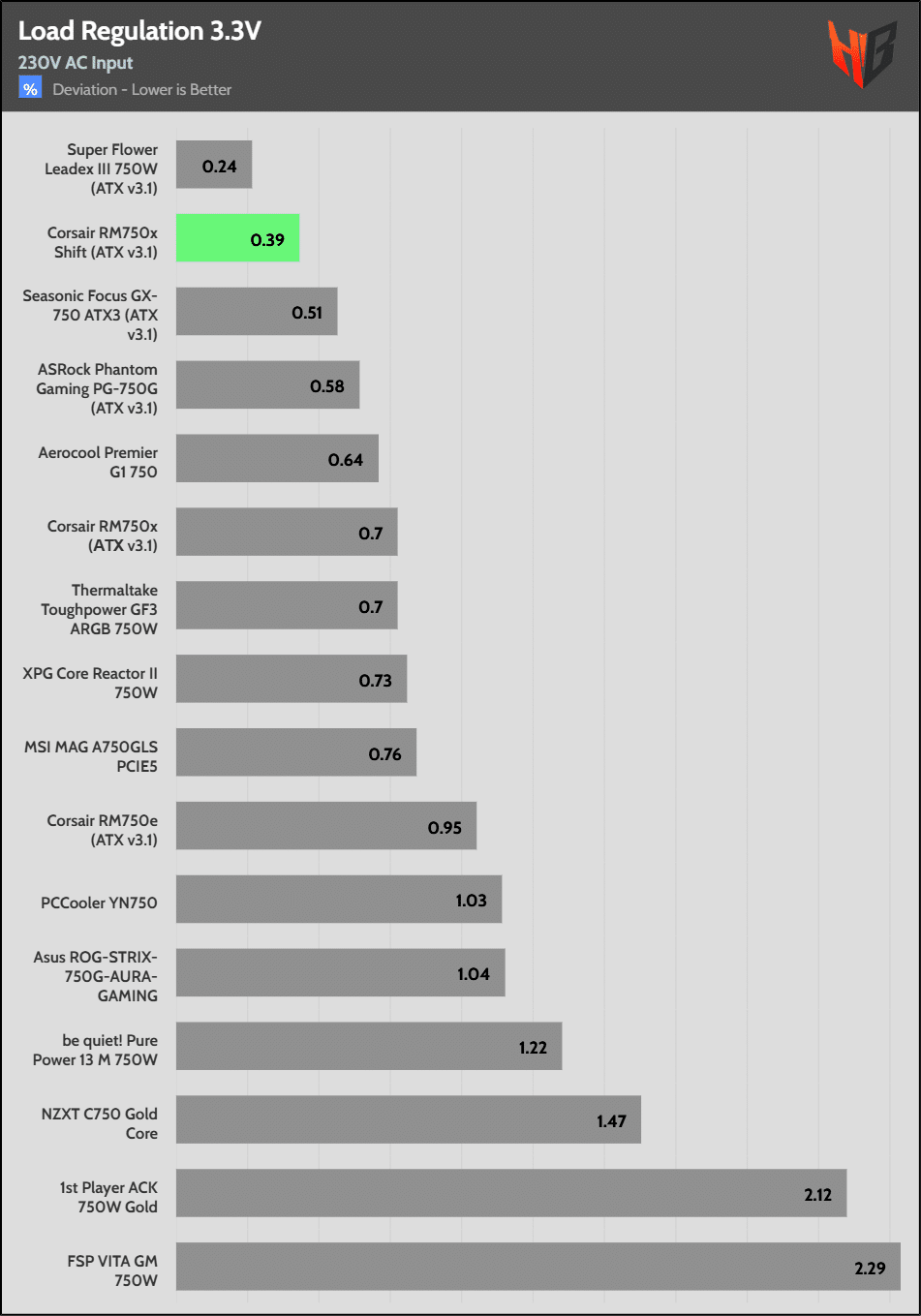
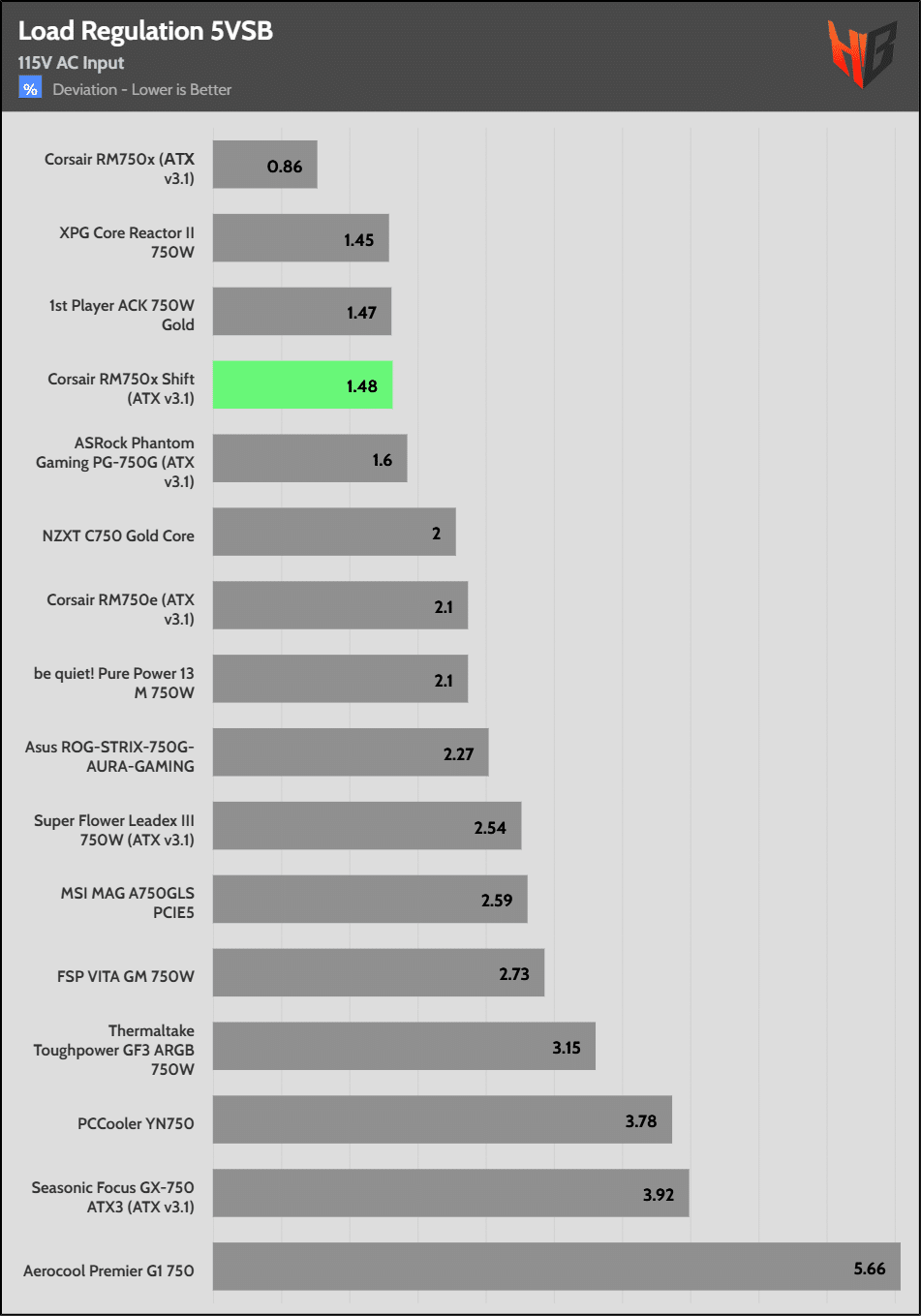
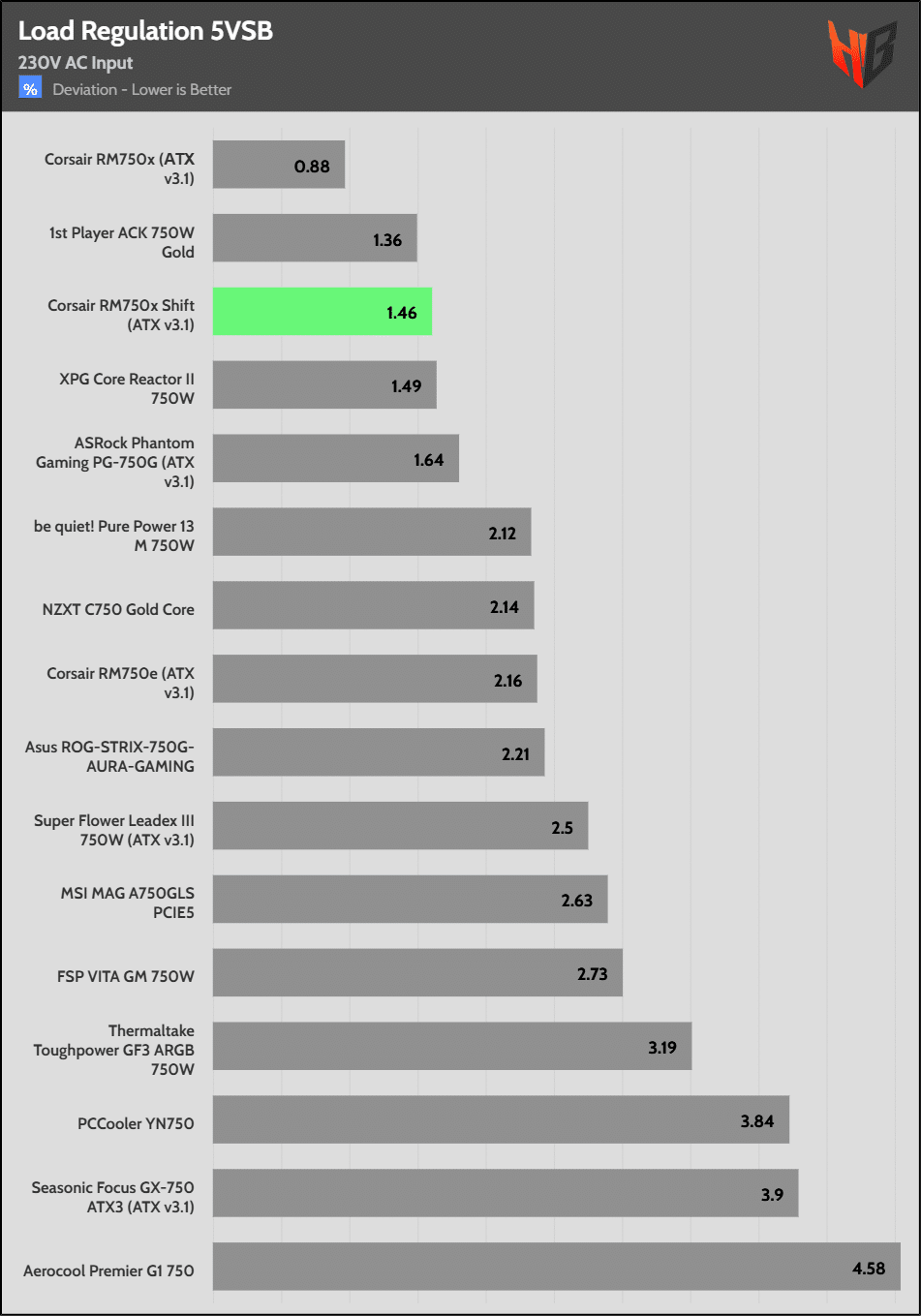
Load regulation is within 1% on all primary rails.
| Test | 12V | 5V | 3.3V | 5VSB | DC/AC (Watts) | Efficiency | Fan Speed (RPM) | PSU Noise (dB[A]) | Temps (In/Out) | PF/AC Volts |
| 20W | 1.242A | 0.503A | 0.498A | 0.198A | 20.008 | 75.53% | 0 | <6.0 | 40.68°C | 0.858 |
| 11.969V | 4.973V | 3.312V | 5.063V | 26.422 | 36.69°C | 114.94V | ||||
| 40W | 2.732A | 0.704A | 0.698A | 0.297A | 40.006 | 81.034% | 0 | <6.0 | 43.5°C | 0.93 |
| 11.967V | 4.973V | 3.312V | 5.061V | 49.369 | 37.96°C | 114.94V | ||||
| 60W | 4.224A | 0.905A | 0.897A | 0.396A | 60.004 | 84.836% | 0 | <6.0 | 43.17°C | 0.952 |
| 11.964V | 4.973V | 3.311V | 5.058V | 70.755 | 38.34°C | 114.94V | ||||
| 80W | 5.714A | 1.107A | 1.096A | 0.495A | 79.971 | 86.269% | 0 | <6.0 | 44.1°C | 0.963 |
| 11.960V | 4.972V | 3.311V | 5.056V | 92.704 | 39.24°C | 114.94V |
A glance at the light-load table is always useful, as the PSU typically operates at light loads.
Ripple Suppression
Ripple in power supplies refers to the small, unwanted AC voltage fluctuations superimposed on the DC output. It occurs due to imperfect filtering during the AC-to-DC conversion. Lower ripple is highly preferable because it ensures a cleaner, more stable DC output, reducing noise and potential interference in sensitive electronics, improving performance, and extending component lifespan. High ripple can cause instability, overheating, or damage to connected devices.
| Test | 12V | 5V | 3.3V | 5VSB | Pass/Fail |
| 10% Load | 11.6 mV | 8.8 mV | 4.6 mV | 8.5 mV | Pass |
| 20% Load | 18.9 mV | 8.7 mV | 4.6 mV | 9.3 mV | Pass |
| 30% Load | 10.5 mV | 8.5 mV | 5.2 mV | 9.1 mV | Pass |
| 40% Load | 11.1 mV | 8.7 mV | 5.8 mV | 10.0 mV | Pass |
| 50% Load | 11.7 mV | 9.4 mV | 7.2 mV | 9.4 mV | Pass |
| 60% Load | 11.7 mV | 9.9 mV | 6.1 mV | 9.9 mV | Pass |
| 70% Load | 12.7 mV | 10.0 mV | 7.2 mV | 10.2 mV | Pass |
| 80% Load | 12.8 mV | 11.4 mV | 9.3 mV | 10.8 mV | Pass |
| 90% Load | 13.7 mV | 10.6 mV | 10.0 mV | 10.6 mV | Pass |
| 100% Load | 20.7 mV | 11.7 mV | 10.8 mV | 14.0 mV | Pass |
| 110% Load | 22.8 mV | 12.2 mV | 13.4 mV | 15.1 mV | Pass |
| Crossload 1 | 13.9 mV | 13.9 mV | 11.3 mV | 10.4 mV | Pass |
| Crossload 2 | 15.9 mV | 11.8 mV | 5.0 mV | 11.1 mV | Pass |
| Crossload 3 | 11.0 mV | 11.5 mV | 10.2 mV | 9.8 mV | Pass |
| Crossload 4 | 19.6 mV | 9.3 mV | 6.2 mV | 8.4 mV | Pass |
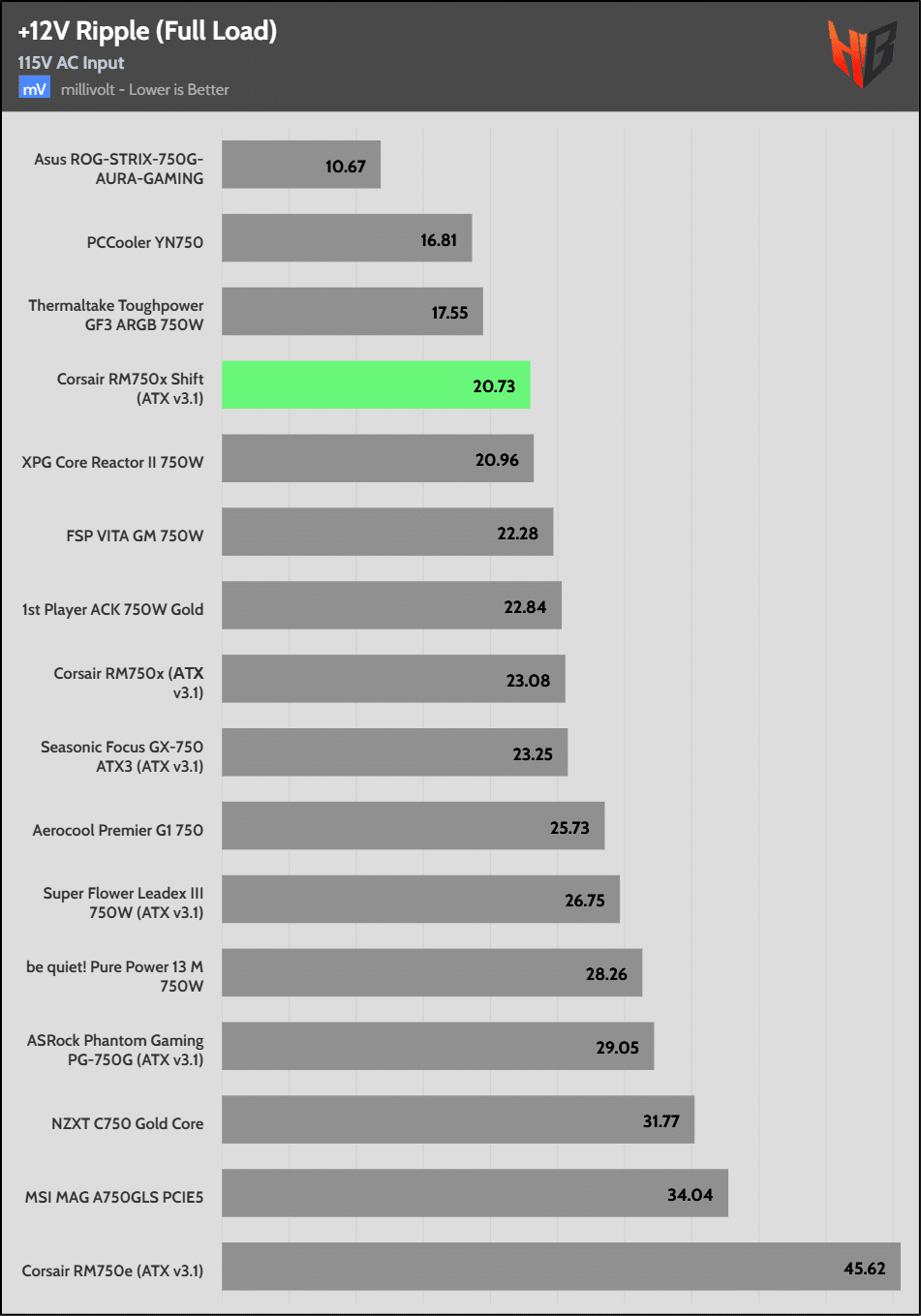
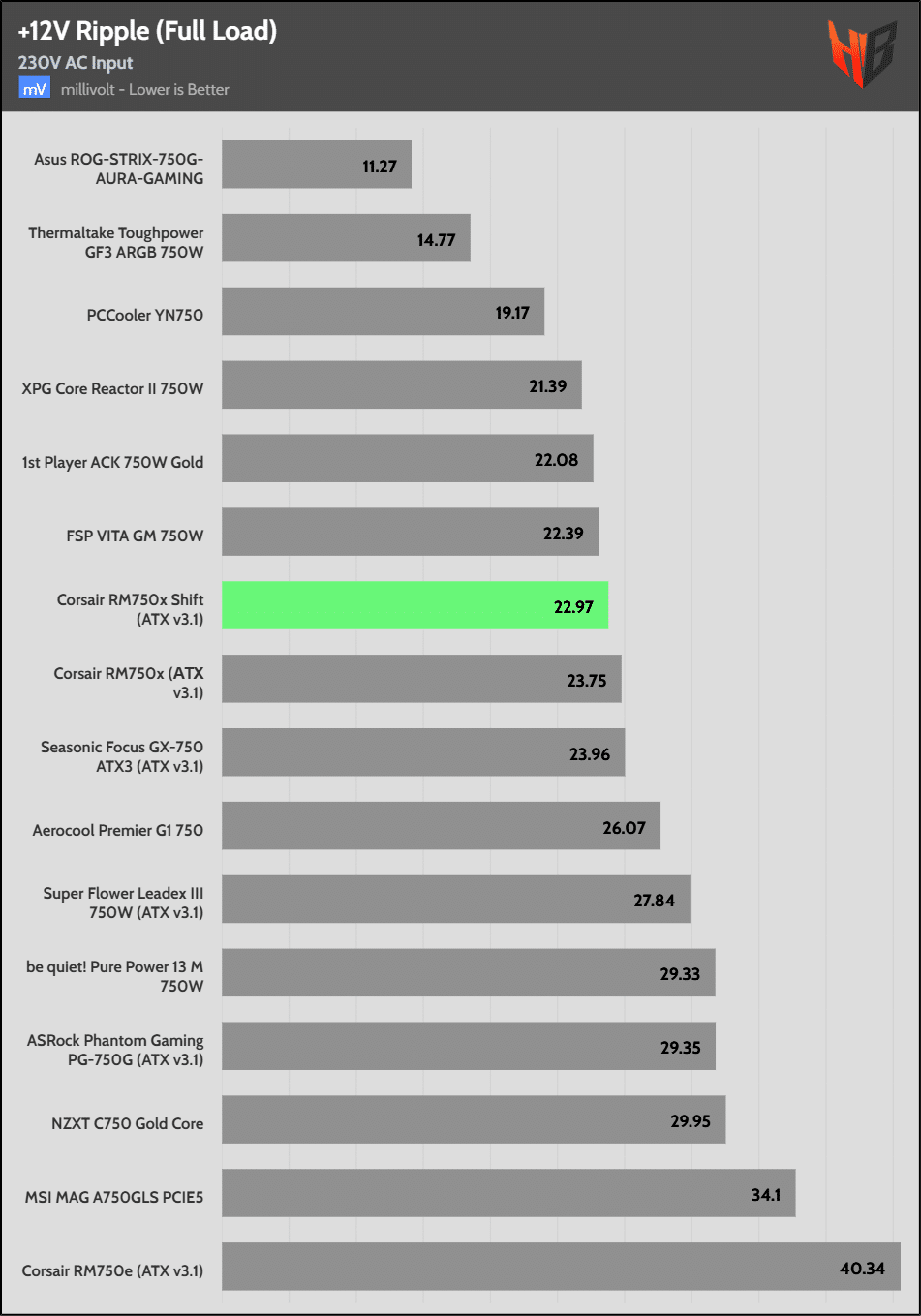
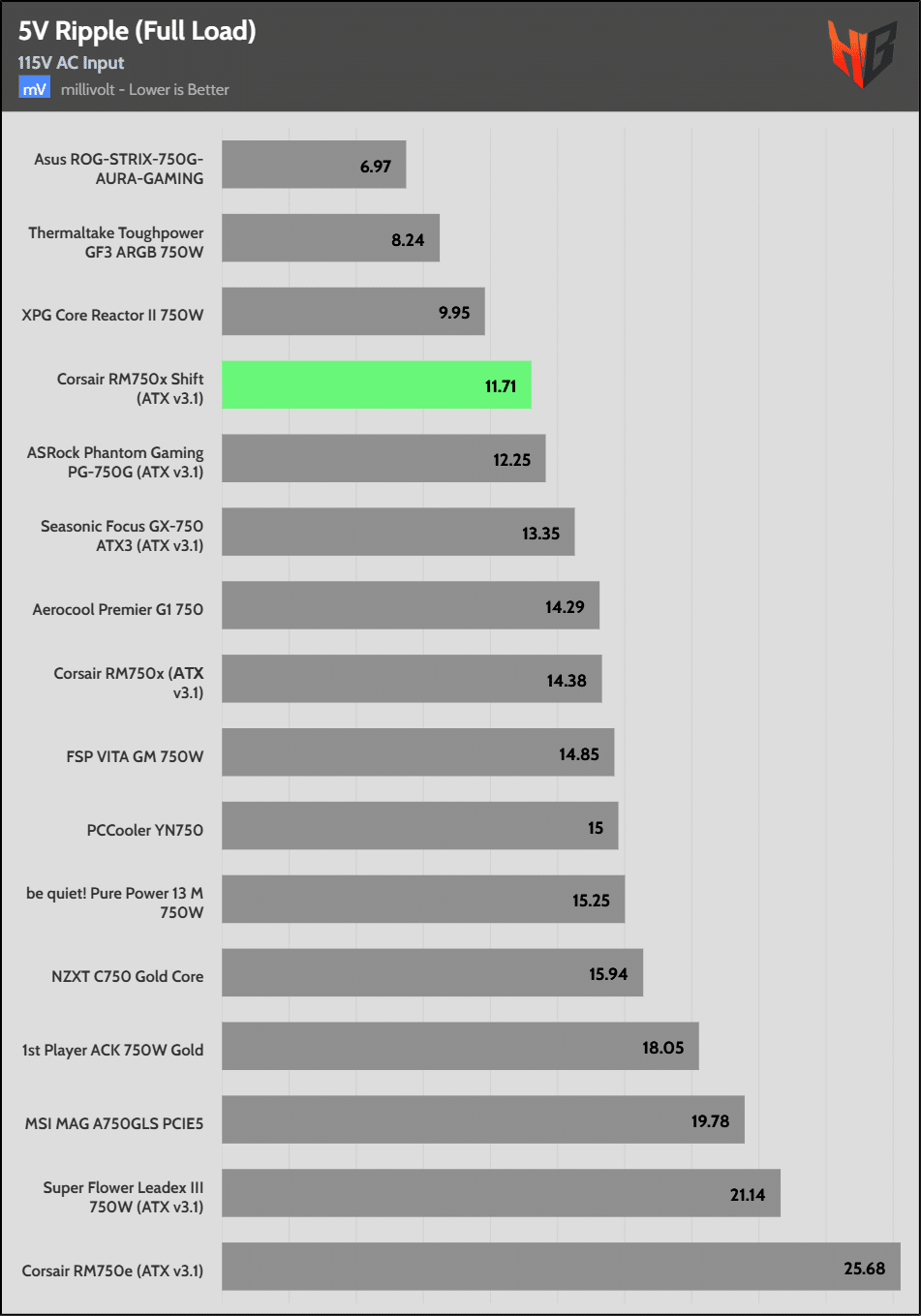
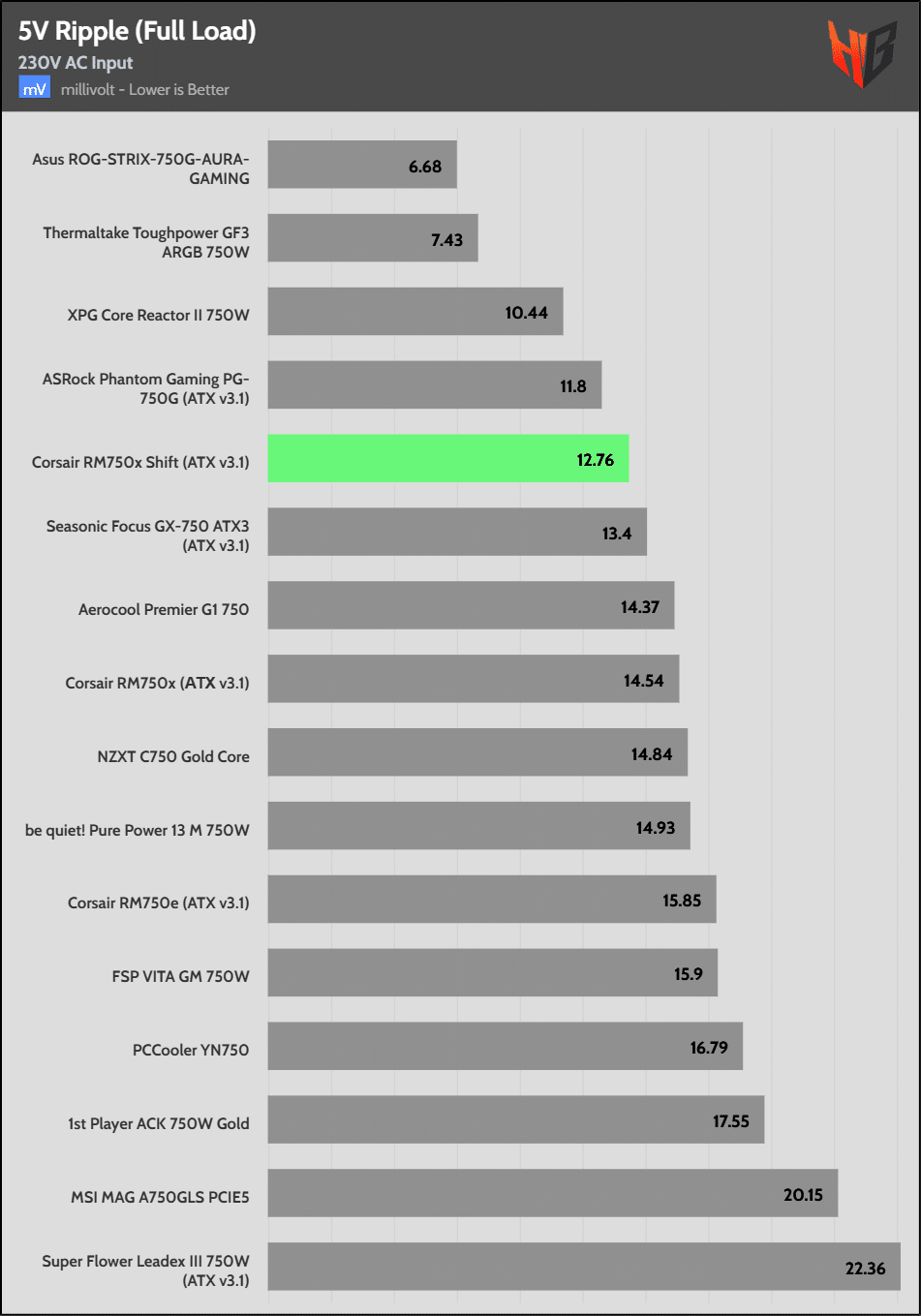
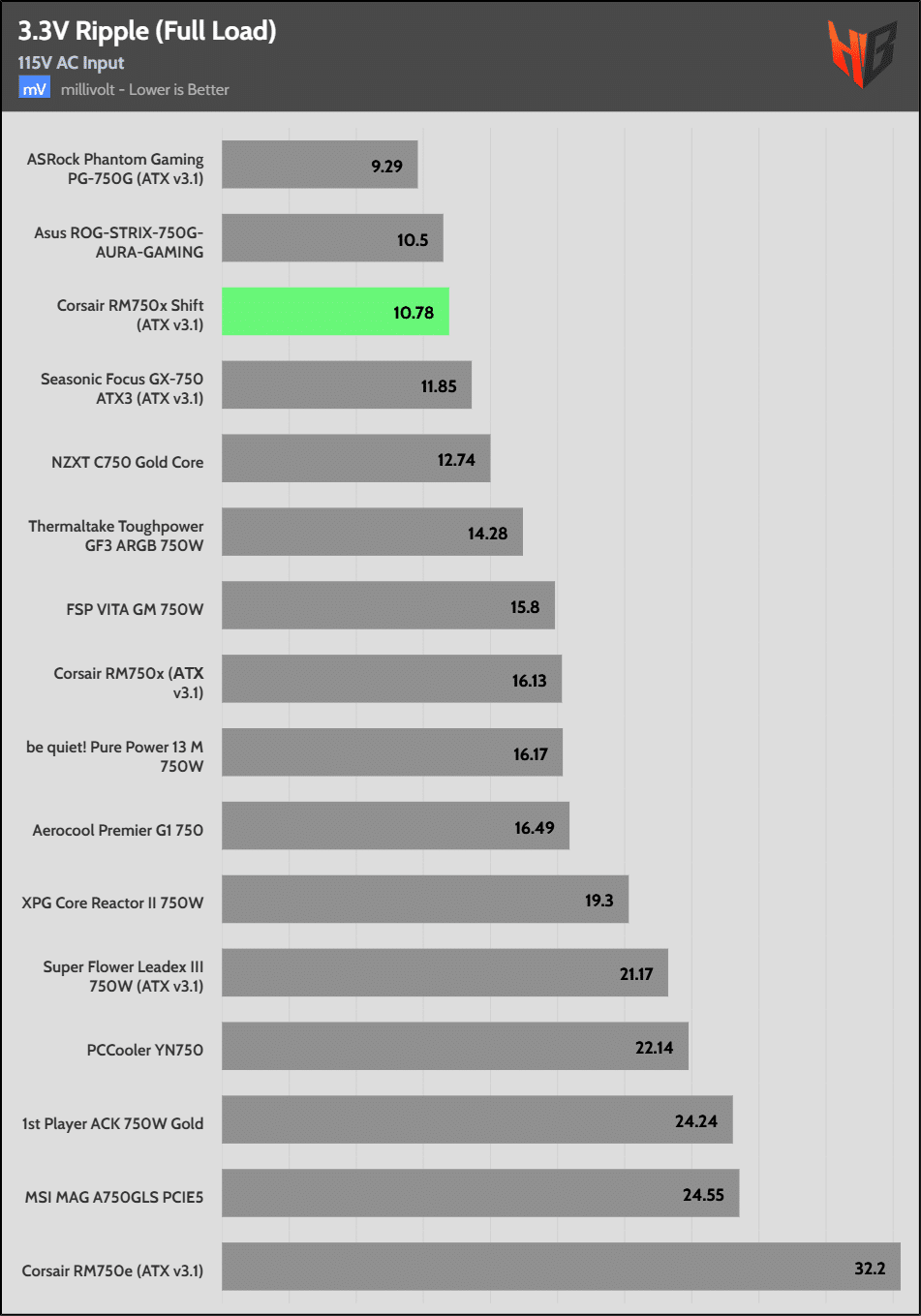
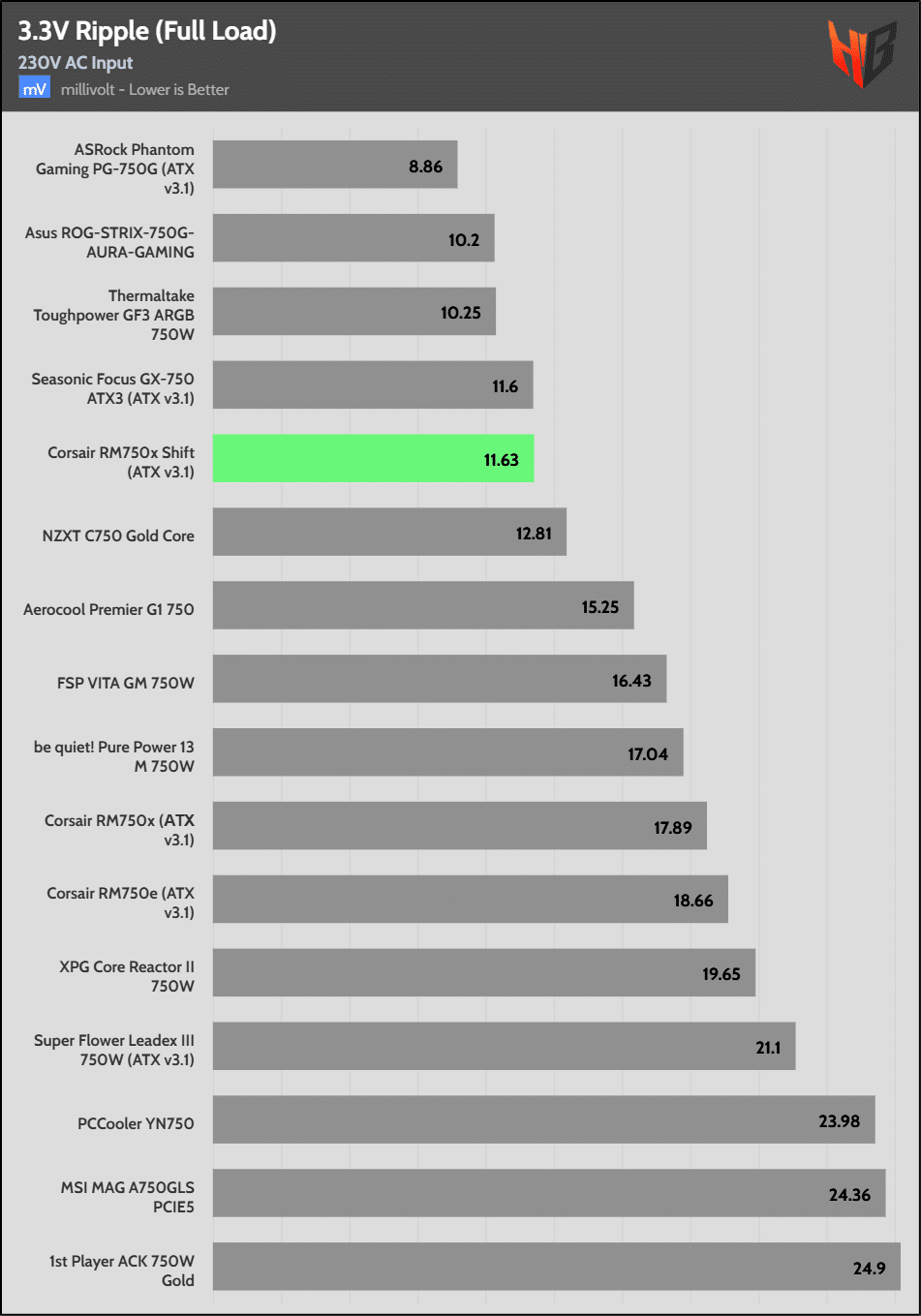
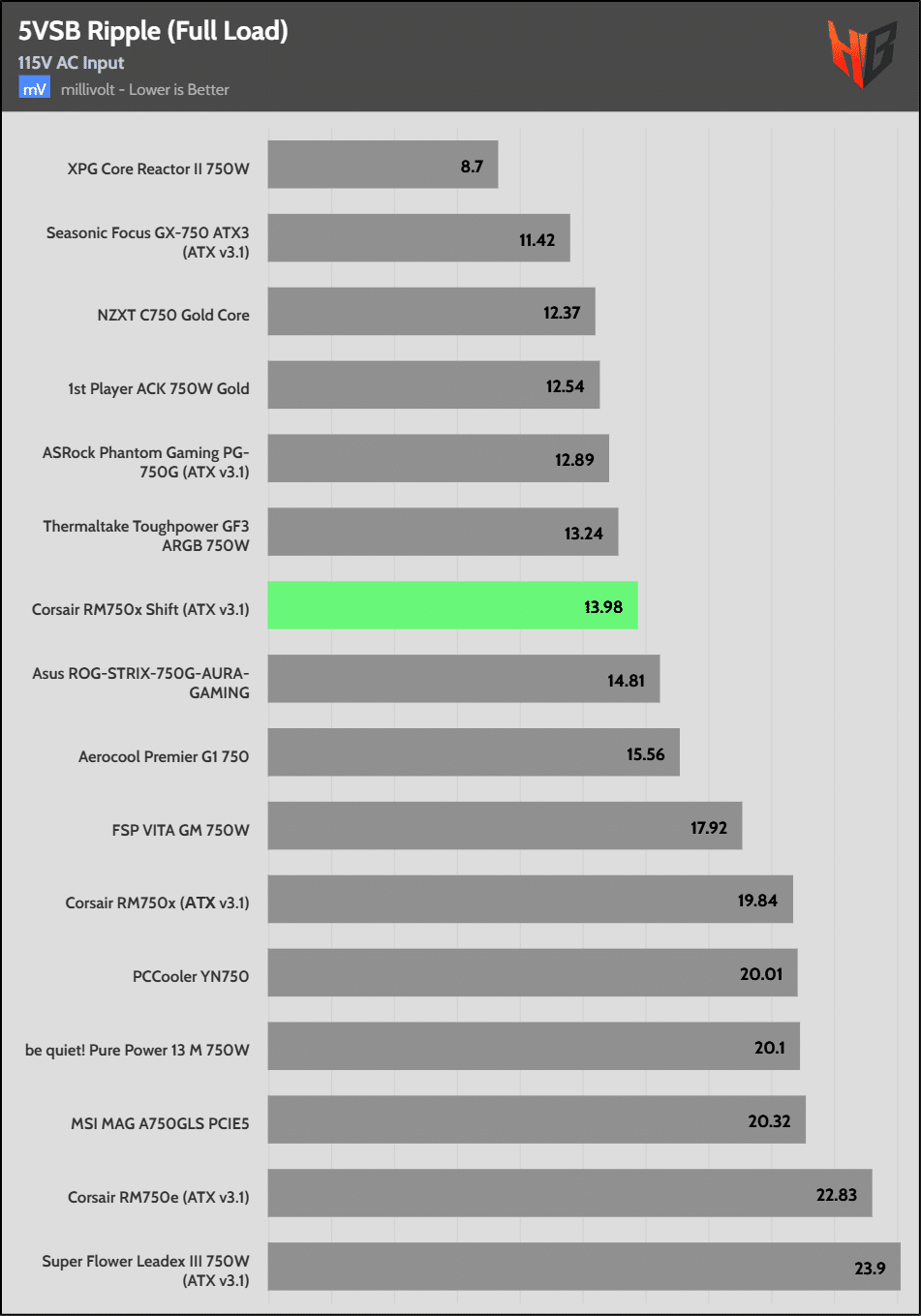
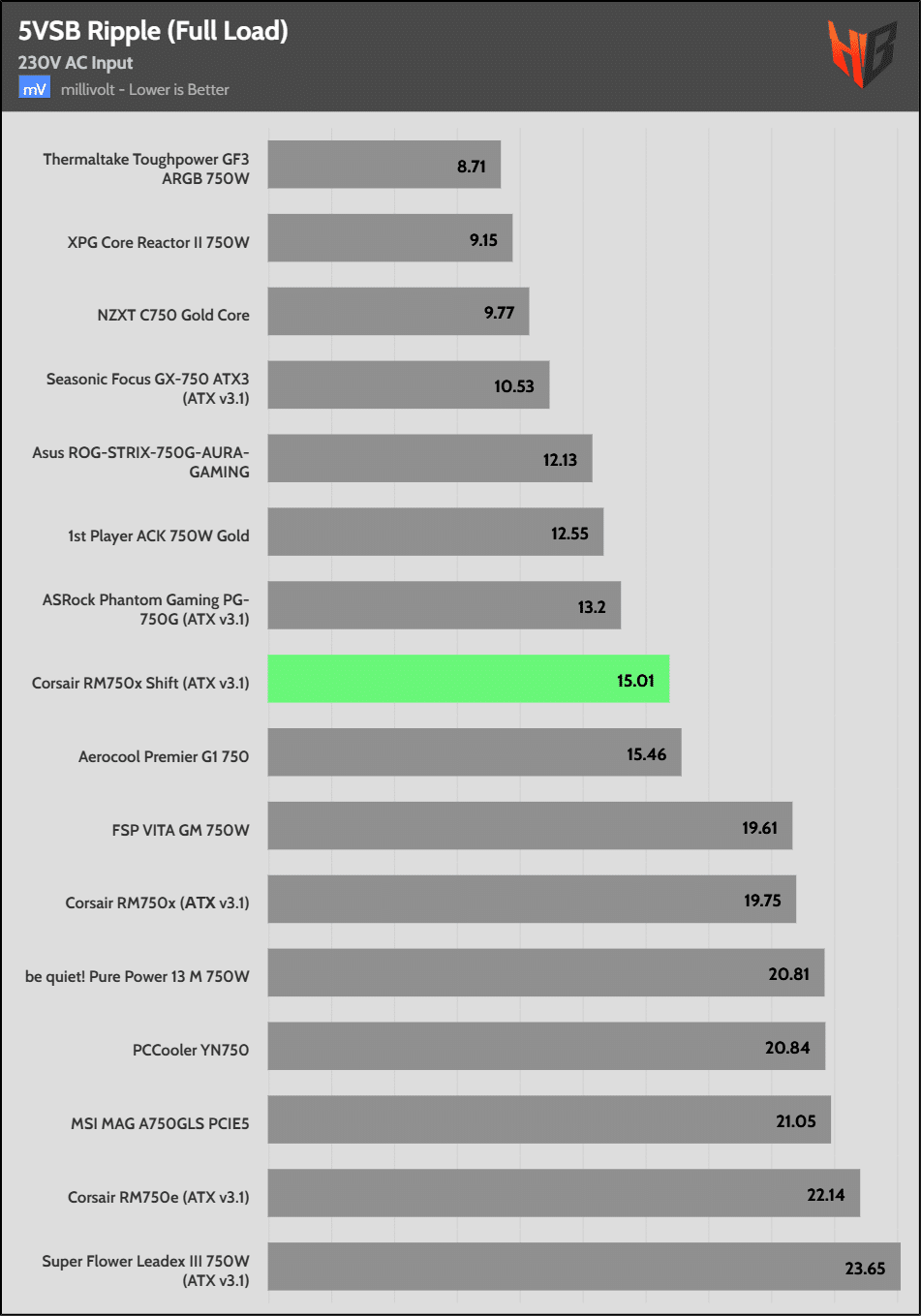
Ripple suppression is good overall.
I would love to see the FSP Mega Ti next up 🙏
Waiting ages for a good honest review.
will try to do it at some time. Sorry being over my head with other things lately.
hello Aris did this PSU legit certified by cybenetics ? https://vsptech.vn/bo-nguon-sfx-vsp-vgf850-cybenetics-gold-850w-atx31-pci-e51-fully-modular.html
i also asking how about this product, did this also had same legit cybenetics certificate https://www.kissquiet.com.tw/copy_productdetail_162651.html?pid=5889399&_t=1761816168
You always praised Corsair for fan failure protection yet with this new shift line they don’t have it anymore you say. Also other protections are not to your liking either. I dislike Corsair because how they treat things so if there is a similar alternative then i chose that.
I think the Pure Power 13 M is a good alternative based on your test and a newly released Dark Power 14 too which also performed well in your tests just no review up yet.
Your test method for Inrush current is different now as you noted, the numbers are different, what threshold would you call good result?
Most PSUs nowadays still don’t have fan failure protection, I am afraid. This is why I am pushing so much through reviews to force them to implement it.
Below 100A is generally considered safe/ok.