Protection Features
Desktop power supply units (PSUs) include several protection features to safeguard both the PSU itself and the connected PC components (motherboard, CPU, GPU, drives, etc.). These protections prevent damage from electrical faults, overloads, or abnormal conditions.
| OCP (Normal @ 28.5°C) | 12V1: 47.4A (143.64%), 11.909V 12V2: 51.8A (156.97%), 11.762V 12V3: 52.4A (131.0%), 11.77V 12V4: 52.4A (131.0%), 11.795V 5V: 31.3A (130.42%), 5.057V 3.3V: 30.3A (121.20%), 3.27V 5VSB: 5A (166.67%), 4.884V |
| OCP (Hot @ 45.7°C) | 12V1: 45.9A (139.09%), 11.888V 12V2: 50.40A (152.73%), 11.793V 12V3: 48.1A (120.25%), 11.792V 12V4: 48.1A (120.25%), 11.814V 5V: 31.6A (131.67%), 5.069V 3.3V: 30.1A (120.40%), 3.264V 5VSB: 4.8A (160.00%), 4.862V |
| OPP (Normal @ 26.9°C) | 1257.13W (125.71%) |
| OPP (Hot @ 40.3°C) | 1188.10W (118.81%) |
| OTP | ✓ (118°C @ Heat Sink) |
| SCP | 12V to Earth: ✓ 5V to Earth: ✓ 3.3V to Earth: ✓ 5VSB to Earth: ✓ -12V to Earth: ✓ |
| PWR_OK | Proper Operation |
| UVP (Full Load @ 90V) | ✓ |
| UVP (No Damage @ 80V) | ✓ |
| Conducted Emissions EN55032 & CISPR 32 | ✓ |
| NLO | ✓ |
| Fan Failure Protection | ✗ |
| SIP | Surge: MOV Inrush: NTC & Bypass Relay |
Evaluating the protection features on multiple 12V rail PSUs is a pain. From now on I will combine all 12V rails into one and get over with this.
The 12V OCP triggering points are correctly set. They might look pretty high at 12V1/2, but this is because the nominal amperage is low. Look at how significant the differences are in the OCP triggering points at 12V3 and 12V4 between standard and high temperatures. These rails power the single 12V-2×6 socket.
On the minor rails, the 5V rail’s triggering points are not correctly set, since OCP is higher at high temperatures than at standard temperatures. Although the rail is conservatively set, given its nominal capacity, and the difference is low, this will still prevent me from giving the unit a recommendation badge. On the other hand, the 3.3V rail is set correctly, although 30A on this rail are not required by any modern system.
The over-power protection is correctly set, and the rest of the protection features are present and work well. My only complaint is that fan failure protection is not present, which should be standard on a high-end platform.
EMC Pre-Compliance at a Glance
Every electronic device, including PSUs, can be an EMI source, and the amount of EMI it emits can affect the proper operation of nearby devices. EMI can, in some extreme cases, even render them unusable. Some standards have been established to minimize electromagnetic interference (EMI) noise. The corresponding standards for IT (Information Technology) products are CISPR 32 and its derivative, EN 55032, which applies to products sold in the EU. In the EU, every product bearing the “CE” marking must comply with the EN 55032 standard. CISPR 32 and EN 55032 standards categorize devices into two classes: A and B. Class B equipment is intended for domestic environments. Hence, its permitted EMI emissions are significantly lower than those of A-class devices.
Our equipment for EMI readings:
- Rohde & Schwarz FPC1500 (loaded with all options)
- Tekbox TBLC08 LISN
- Tekbox TBFL1 transient limiter
- Tekbox EMCview software
| CISPR 32 / EN55032 Limits | ||
| CISRP 32 / EN 55032 Class A Conducted EMI Limit | ||
| Frequency of Emission (MHz) | Conducted Limit (dBuV) | |
| Quasi-peak | Average | |
| 0.15 – 0.50 | 79 | 66 |
| 0.50 – 30.0 | 73 | 60 |
| CISPR 32 / EN 55032 Class B Conducted EMI Limit | ||
| Frequency of Emission (MHz) | Conducted Limit (dBuV) | |
| Quasi-peak | Average | |
| 0.15 – 0.50 | 66 – 56 | 56 – 46 |
| 0.50 – 5.00 | 56 | 46 |
| 5.00 – 30.00 | 60 | 50 |
| CISRP 32 / EN 55032 Class A 10-Meter Radiated EMI Limit | ||
| Frequency of Emission (MHz) | Field Strength Limit (dBuV/m) | |
| 30 – 88 | 39 | |
| 88 – 216 | 43.5 | |
| 216 – 960 | 46.5 | |
| > 960 | 49.5 | |
| CISRP 32 / EN 55032 Class B 3-Meter Radiated EMI Limit | ||
| Frequency of Emission (MHz) | Field Strength Limit (dBuV/m) | |
| 30 – 88 | 40 | |
| 88 – 216 | 43.5 | |
| 216 – 960 | 46.0 | |
| > 960 | 54.0 | |
Please note that the ATX spec allows a 4 dB margin for conducted and radiated emissions. This means that if a PSU exceeds the limits but stays within the 4 dB margin, it meets the corresponding ATX spec requirement (8.1 Emissions).
EMI Results
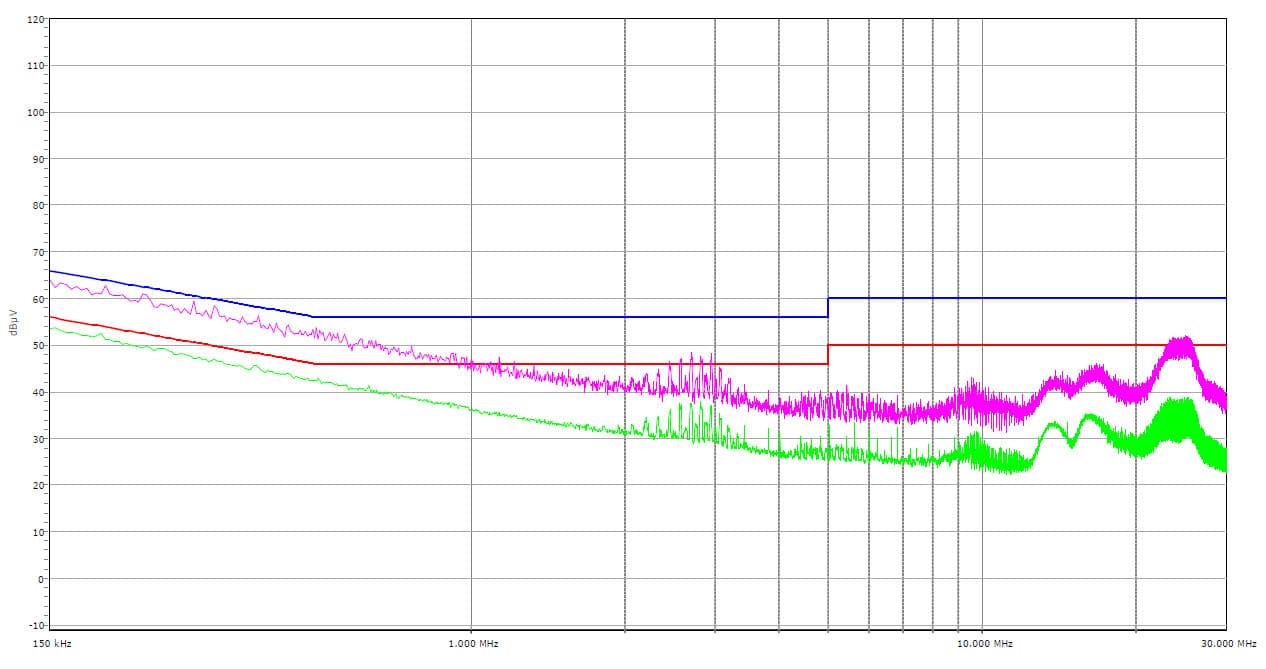
The PSU’s EMI emissions are under control.
Thanks for the review, only the 850W has left. Would you say that the Pure Power 13 M is a better choice? Dark Power 14 does not seem to be as much better as the price increase would suggest.
Aris, when you ill add the certification of husky 1200w on database?!
We have them in the pipeline but we also have around 40x samples in front of it so it will take some time