Calling someone a “computer” has long been shorthand for fast thinking. But while today’s electronic computers would utterly outpace the human “computers” of NASA’s early days, a new kind of machine could soon make even modern GPUs look sluggish. Instead of electrons, it uses light.
Optical computing, which processes information using photons rather than electrical signals, operates at the speed of light and promises massive gains in speed, efficiency, and parallelism. And now, researchers in Finland and China have demonstrated a breakthrough that could push it far beyond the lab and into real-world AI systems.
Why GPUs Are Hitting A Wall
The demand for computing power isn’t driven just by gaming or streaming. Artificial intelligence, large language models, image recognition, and data analytics are producing a data explosion that today’s hardware struggles to keep up with.
Graphics processing units (GPUs), the backbone of modern AI, face three growing problems:
- Limited scalability
- Enormous energy consumption
- Rising cooling and water demands
As multiple reports have highlighted, AI data centers packed with GPUs consume staggering amounts of electricity, often from non-renewable sources, and large volumes of water, often in already-stressed regions.
That makes alternatives not just desirable, but necessary.
Computing With Light, Not Electrons
In a paper published in Nature Photonics, researchers led by Yufeng Zhang (Aalto University, Finland) and Xiaobing Liu (Chinese Academy of Sciences) unveiled a method called single-shot tensor computing at light speed.
Their approach performs complex calculations using a single propagation of coherent light, a technique known as parallel optical matrix–matrix multiplication (POMMM).
“Our method performs the same kinds of operations that today’s GPUs handle, such as convolutions and attention layers, but does them all at the speed of light,” Zhang explains.
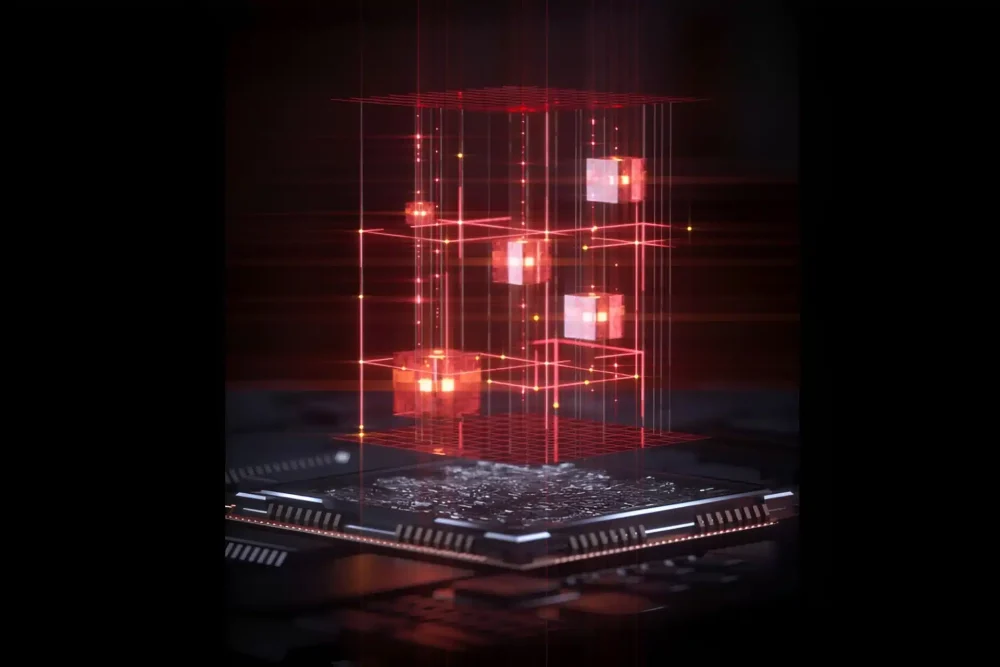
Instead of encoding data as binary ones and zeros flowing through electronic circuits, the system uses the amplitude and phase of light waves to store and process information. The result is extreme parallelism, massive bandwidth, and dramatically lower energy use.
Why Tensors Matter
At the heart of modern AI are tensors, multi-dimensional data structures that underpin neural networks, natural language processing, and image recognition.
GPUs process tensors through repeated matrix–matrix multiplications, a method that is powerful but energy-hungry and memory-intensive. Optical systems, by contrast, naturally perform mathematical operations as light waves interact.
Until now, optical tensor processing required multiple light passes, making it inefficient for real-world neural networks. The breakthrough from Aalto and its collaborators eliminates that limitation by completing the entire tensor operation in a single shot, fully in parallel.
One Pass, Everything Computed
Zhang offers a simple analogy:
“Imagine inspecting parcels at customs using multiple machines, one after another. Our optical method merges all parcels and machines together. With one pass of light, all inspections and sorting happen instantly.”
That single-pass design is what makes the approach so powerful and so disruptive.
In experimental demonstrations, the researchers showed that their optical system closely matches the results of standard GPU-based matrix calculations, even when scaled to complex neural network architectures such as convolutional neural networks and vision transformers.
From Lab Optics To Photonic Chips
The current prototype uses conventional optical components, including lasers, spatial light modulators, and lenses. But the long-term goal is far more ambitious.
“This approach can be implemented on almost any optical platform,” says Zhipei Sun, leader of Aalto University’s Photonics Group. “We plan to integrate this computational framework directly onto photonic chips.”
If successful, future light-based processors could perform complex AI tasks with extremely low power consumption, while bypassing many of the physical limits that constrain electronic chips.
A Future Beyond GPUs?
The researchers estimate that integration with existing hardware platforms could be achieved within 5 years. Rather than replacing GPUs overnight, optical computing could first act as a specialized accelerator for the most demanding AI workloads.
If that vision holds, the implications are profound: faster AI training, lower energy costs, reduced environmental impact, and a new generation of computing systems operating quite literally at light speed.
For an industry searching for a way past the GPU bottleneck, the answer may already be racing through a beam of light.