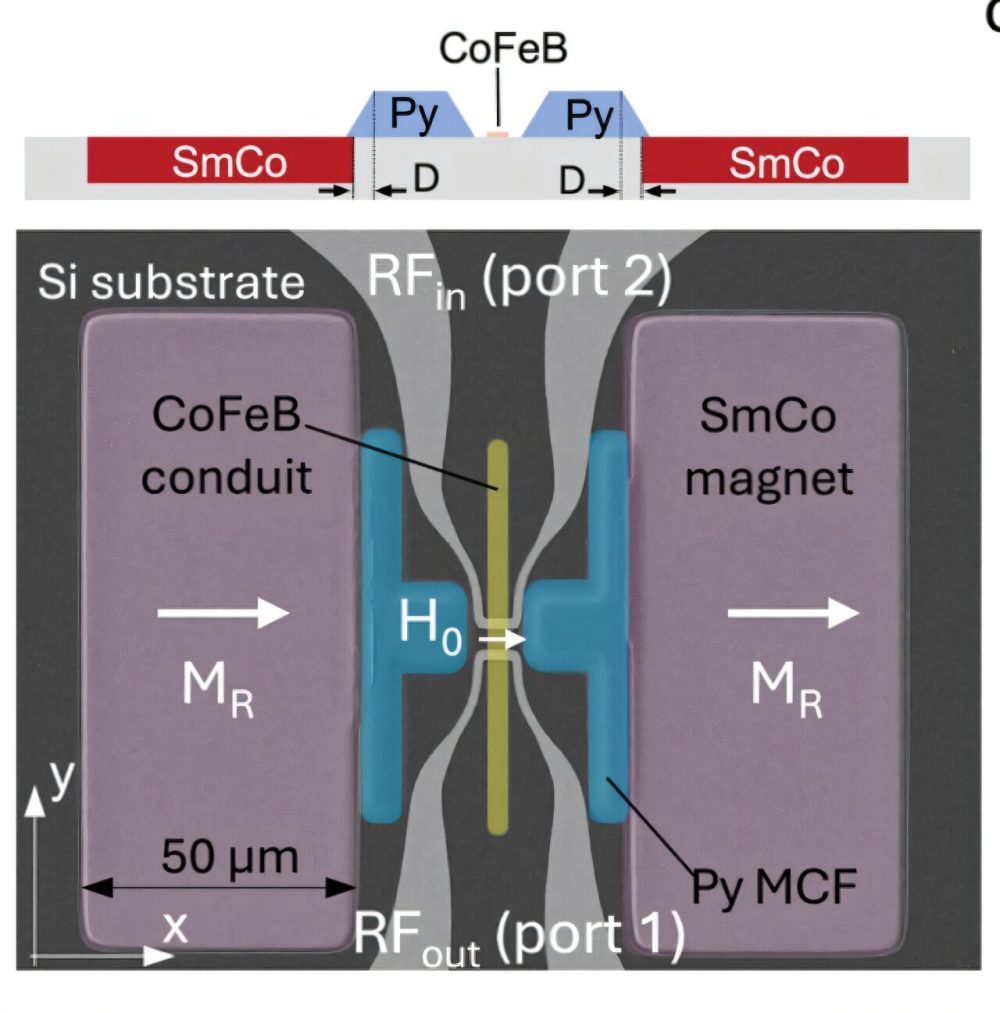
Researchers at Politecnico di Milano, in collaboration with teams from Rheinland-Pfälzische Technische Universität and Italy’s CNR-IOM, have developed the world’s first fully integrated and tunable spin-wave microchip, one that operates without bulky external magnets, clearing a major obstacle toward real-world use in telecommunications and beyond.
Why This Is a Big Deal
Until now, spin-wave technology, which uses magnetic waves instead of electrical currents to process signals, required an external magnetic field to function. That made it impractical for integration into chips. This new design eliminates that need by using microscopic permanent magnets and magnetic flux concentrators, all built directly into the chip.
Key Features of the Chip
- Size: Only 100 × 150 micrometers, far smaller than current radio-frequency components.
- Frequency range: Tunable between 3–8 GHz, covering frequencies relevant to 5G, 6G, and beyond.
- Energy efficiency: The built-in SmCo micromagnets require no power to maintain the magnetic field.
- Heat resistance: Stable at temperatures up to 200°C, suitable for industrial and automotive applications.
How It Works
The chip contains a waveguide made of magnetic material (CoFeB), with tiny antennas to send and receive radio-frequency signals. The magnetic field strength, and thus the operating frequency, is finely adjusted by changing the distance between the built-in magnets and flux concentrators.
The team has already demonstrated the chip’s ability to act as a time delay line and phase shifter, key components in telecom signal processing, without any external bias.
Next Steps
The breakthrough is part of the European MandMEMS project, which aims to develop compact, reconfigurable, and efficient communication devices for future 6G networks and high-frequency electronics. According to project coordinator Philipp Pirro, the next step is to increase transmission efficiency and move toward market-ready devices.
Broader Impact
This chip opens doors not only to faster, lower-power telecom hardware, but also to advances in:
- Consumer electronics
- Automotive radar and sensors
- Medical diagnostics
- Any system requiring integrated high-frequency signal processing
As lead researcher Riccardo Bertacco stated, this is a “decisive step” toward moving spin-wave technology out of the lab and into real devices that could redefine the future of wireless communication.