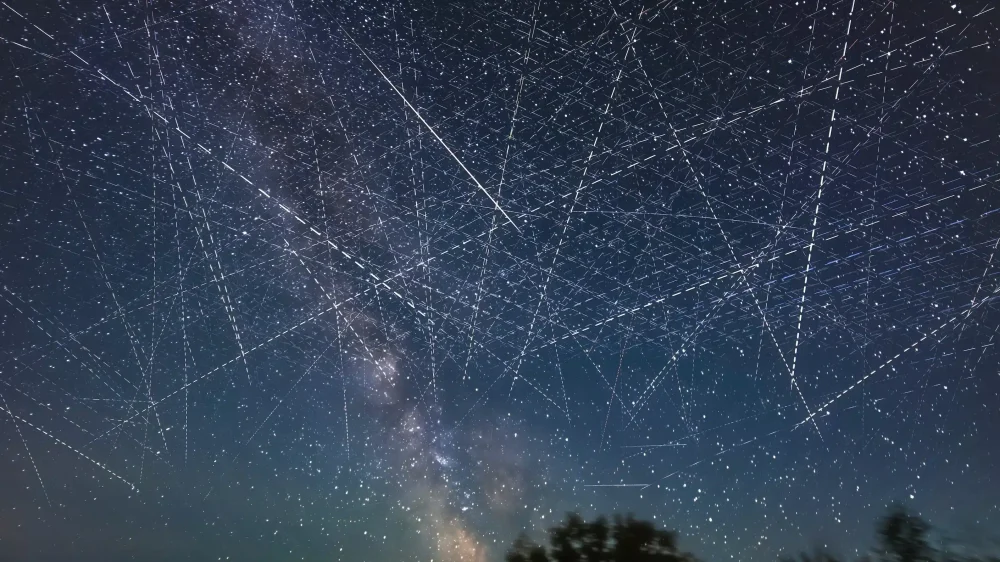
NATO intelligence warns of a “zone-effect” anti-satellite weapon designed to cripple Starlink, and possibly low Earth orbit itself.
Russia is reportedly developing a new type of anti-satellite weapon aimed squarely at Elon Musk’s Starlink constellation, according to intelligence assessments from two NATO member states reviewed by The Associated Press.
The alleged system, described as a so-called “zone-effect” weapon, would flood Starlink’s low Earth orbit (LEO) with hundreds of thousands of high-density pellets, potentially disabling large numbers of satellites at once. The danger, analysts warn, is that such an attack would not stop with Starlink; it could destabilize entire orbital regions and threaten spacecraft belonging to many nations, including Russia itself.
A Direct Threat to Ukraine’s Digital Lifeline
Starlink has become a critical asset for Ukraine since Russia’s full-scale invasion began more than three years ago. The network’s thousands of low-orbit satellites provide high-speed internet for battlefield communications, drone coordination, weapons targeting, and civilian connectivity where infrastructure has been destroyed.
According to intelligence findings, Moscow now views Starlink not just as commercial infrastructure but also as a strategic military enabler and therefore a legitimate target.
Russian officials have repeatedly warned that commercial satellites supporting Ukraine’s military could be attacked. This month, Moscow also announced it had fielded its S-500 air and missile defense system, which it claims can strike targets in low Earth orbit.
How the ‘Zone-Effect’ Weapon Would Work
Unlike traditional anti-satellite missiles, which destroy one satellite at a time and generate trackable debris, the reported Russian concept is far more indiscriminate.
The weapon would allegedly deploy clouds of millimeter-sized metallic pellets, possibly released from small satellites yet to be launched. These pellets would be difficult to detect with existing space surveillance systems, making attribution harder and allowing Russia to deny responsibility plausibly.
Even tiny particles can be devastating at orbital speeds. Experts say solar panels would likely be the first point of failure, and damage there could be enough to knock satellites offline entirely.
Starlink currently operates more than 8,500 satellites, most of which orbit at about 550 kilometers above Earth.
Why Experts Are Skeptical
Despite the alarming nature of the claims, many space-security experts remain unconvinced that such a weapon could be used without triggering uncontrollable consequences.
“I don’t buy it. Like, I really don’t,” said Victoria Samson, space-security specialist at the Secure World Foundation. “I would be very surprised, frankly, if they were to do something like that.”
The problem is physics and fallout.
“You blow up a box full of BBs,” said Brig. Gen. Christopher Horner, commander of Canada’s Space Division. “You blanket an entire orbital regime. You don’t just take out Starlink—you take out everything in that zone.”
That includes satellites used by Russia and China for communications, navigation, intelligence, and defense.
China’s Tiangong space station and the International Space Station, which operate at lower orbits, could also face increased collision risks as debris slowly decays toward Earth.
A Weapon Designed to Be Feared, Not Fired
Several analysts believe the system—if it exists at all—may be more about deterrence than deployment.
“It definitely feels like a weapon of fear,” said Clayton Swope of the Center for Strategic and International Studies. “Something that threatens chaos without necessarily having to be used.”
Samson echoed that view, suggesting the project could be experimental or even political.
“Sometimes these ideas get floated to justify increased spending on counterspace weapons or to provoke a stronger response from the West,” she said. “That has happened before.”
The intelligence assessments seen by AP do not specify when—or if—Russia could deploy such a system. An official familiar with the findings said development is ongoing, but details remain highly sensitive.
Space as the Next Battlefield
Russia denies pursuing nuclear or space-based weapons and has publicly called for international efforts to prevent the weaponization of orbit. Yet Western officials point to a pattern of increasingly aggressive behavior in space.
France’s Space Command said Russia has been engaging in “irresponsible, dangerous, and even hostile actions” in orbit in recent years.
If the reported pellet weapon were ever used, the consequences could be historic—not just for Starlink, but for the viability of low Earth orbit as a shared domain.
As Samson put it bluntly:
“Using such a weapon would effectively cut off space for everyone, including Russia. I don’t know that they’d be willing to give up that much.”