A Beijing-based energy company has successfully launched and connected to the grid what it calls the world’s first megawatt-class airborne wind energy system, marking a major step toward harnessing high-altitude winds for everyday power needs.
The Test Flight
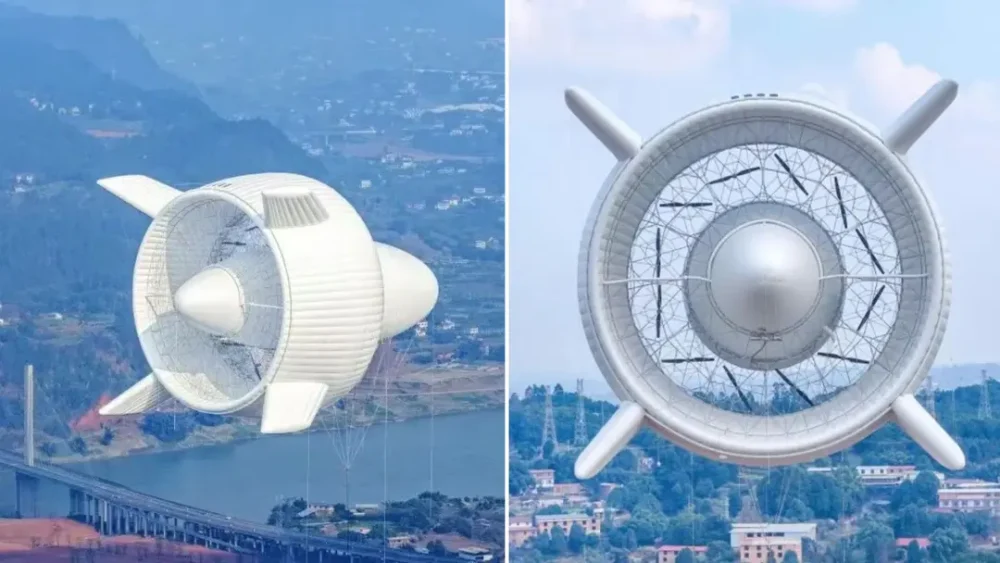
The S2000 Stratosphere Airborne Wind Energy System (SAWES) ascended to 2,000 meters (6,560 feet) above Yibin, Sichuan Province. During its stable hover, it generated 385 kilowatt-hours of electricity and fed it directly into the local power grid, a first for this kind of technology.
How It Works
The system looks like a sci-fi airship and operates on a simple yet clever principle:
- A helium-filled aerostat lifts a lightweight wind-power unit to altitudes where winds are stronger and more consistent.
- Twelve ducted turbines capture and concentrate wind flow, boosting efficiency.
- Electricity travels down a tethered cable, which also stabilizes the platform.
- Rated capacity reaches up to 3 megawatts, comparable to a medium-sized traditional wind turbine.
Its Significance
Ground-based wind turbines are limited by terrain, height, and inconsistent winds. By flying well above these constraints, airborne systems like the S2000 can tap into a far more reliable and powerful wind resource.
Chief Technology Officer Weng Hanke outlined two main applications:
- Off-grid power for remote locations like border outposts.
- Complementing ground-based wind farms to create a “three-dimensional” renewable energy mix.
Next Steps
Manufacturer Beijing Linyi Yunchuan Energy Technology has already begun small-batch production and secured letters of intent from several Chinese cities. A new production base in Zhoushan is expected to ramp up material output to 800,000 linear meters per year by 2028, reducing reliance on imported components.
The Road Ahead
While promising, experts note that long-term reliability, safety, and costs still need to be proven. But if scalable, airborne wind could unlock a new frontier in clean energy — one that flies above the limits of today’s renewables.
For now, the S2000 has shown that harvesting wind from the sky isn’t just a concept — it’s officially grid-connected.