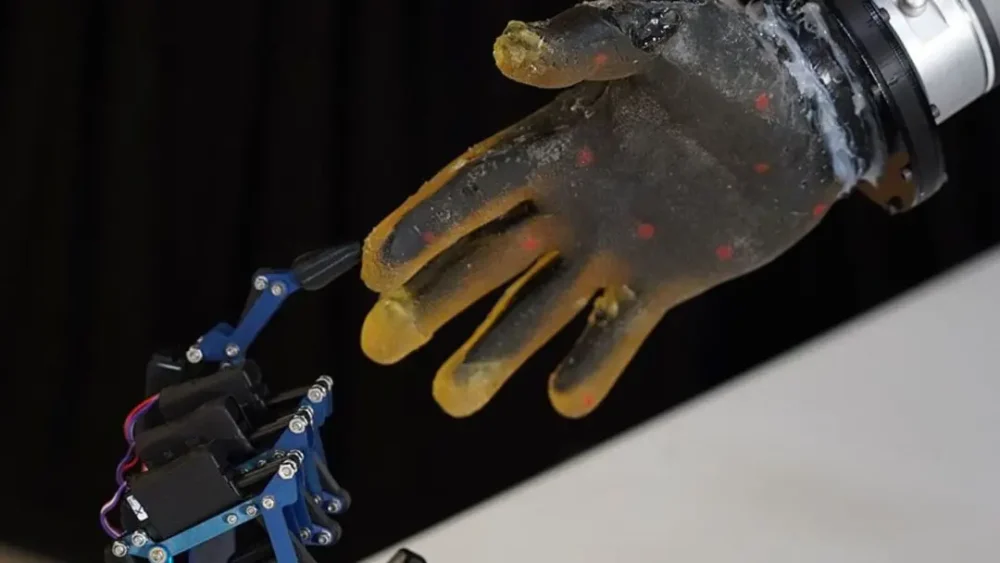
Researchers in China have developed a neuromorphic robotic electronic skin that allows humanoid robots to sense touch, detect injury, and react to harmful contact with lightning-fast, reflex-like movements, much like humans do when they touch something hot or sharp.
In people, pain reflexes don’t wait for the brain to weigh in. Sensory nerves in the skin send signals straight to the spinal cord, triggering an immediate muscle response that pulls the hand away before conscious thought kicks in. This rapid pathway helps prevent serious injury.
Robots, by contrast, usually rely on centralized processing. Sensors detect contact, data is sent to a central processor, decisions are made, and commands are sent back to motors. Even tiny delays can mean cracked components, damaged joints, or safety risks, especially as humanoid robots begin operating in homes, hospitals, and public spaces.
The new neuromorphic robotic e-skin (NRE-skin) is designed to solve that problem by giving robots a more instinctive way to interact with the world.
More Than Just Touch Sensors
Most robotic skins today function like simple pressure pads. They can tell when they’re touched, but not whether the interaction is gentle, dangerous, or damaging.
The NRE-skin goes much further. Inspired by the human nervous system, it converts tactile information into electrical pulse trains similar to biological nerve signals. This allows the robot not only to sense contact, but to understand its severity.
The skin is built from four layers. The outermost layer acts like human epidermis, protecting what lies beneath. Below it are sensors and neuromorphic circuits that continuously monitor pressure, force, and structural integrity.
Even when nothing touches the robot, the skin sends periodic electrical pulses to the central processor — a kind of “all systems normal” signal. If the skin is cut or damaged, those pulses stop, immediately alerting the robot to the injury and its location.
Reflexes Without Thinking
When the robot is touched, the skin generates electrical spikes that encode information about the applied force. Under normal conditions, these signals are sent to the central processor for interpretation.
But when pressure exceeds a preset threshold, indicating potential pain or damage, the system takes a different path.
Instead of waiting for the CPU, the skin sends a high-voltage signal directly to the motors. This bypass triggers an immediate reflex, such as pulling an arm away from a dangerous surface, without any central processing delay.
“Our neuromorphic robotic e-skin features a hierarchical, neural-inspired architecture enabling high-resolution touch sensing, active pain and injury detection with local reflexes, and modular quick-release repair,” the researchers wrote in their paper published in Proceedings of the National Academy of Sciences.
“This design significantly improves robotic touch, safety, and intuitive human–robot interaction for empathetic service robots.”
Built for Real-World Use
The system is also designed with maintenance in mind. The skin consists of magnetic, modular patches that can be snapped off and replaced in seconds — similar to Lego bricks. A damaged section doesn’t require taking the entire robot offline, making repairs faster and far more practical.
The research team’s next goal is to increase the skin’s sensitivity so it can accurately process multiple simultaneous touch points without confusion — a crucial requirement for robots operating in crowded, unpredictable environments.
The Importance
As humanoid robots move beyond factories and into everyday human spaces, slow, centralized reactions are no longer good enough. Robots need reflexes, not just responses. By giving machines a pain-like signal and a way to react instantly, neuromorphic e-skin could dramatically improve robot safety, durability, and trustworthiness, not just protecting the machines themselves, but the people around them. It’s a step toward robots that don’t just sense the world, but instinctively respond to it.