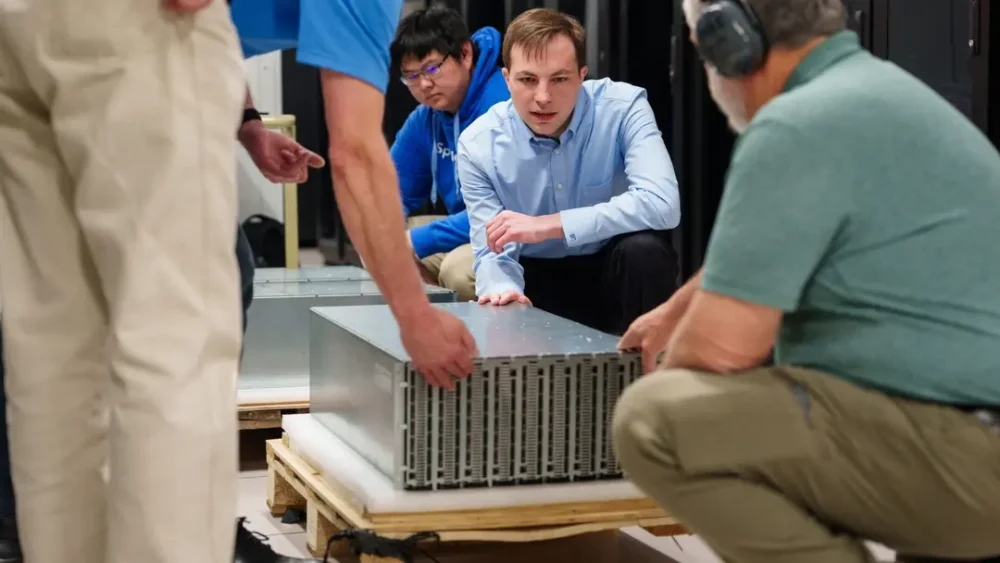
In a breakthrough that could reshape the future of high-performance computing, researchers at Sandia National Laboratories have taught a brain-inspired computer to solve complex mathematical equations,something many experts thought wasn’t possible. This advance edges the world closer to its first neuromorphic supercomputer, a system that could one day model everything from hurricanes to brain diseases with far less energy than today’s machines.
A New Kind of Math Machine
Neuromorphic computers are designed to mimic the structure of the human brain. They’re extremely energy-efficient and great at tasks like recognizing patterns or training AI models, but until now, they weren’t seen as useful for heavy-duty mathematics.
That changed when neuroscientists Brad Aimone and Brad Theilman developed an algorithm that allows neuromorphic hardware to solve partial differential equations (PDEs). PDEs are the mathematical backbone of simulations in weather forecasting, aircraft design, material science, and even nuclear physics.
“What’s exciting is that we’ve taken a well-known model from neuroscience and found a hidden link to applied math,” Theilman explained. “It’s like discovering a secret passage between two fields that have been separate for years.”
Beyond Faster Calculations
The implications stretch far beyond faster simulations:
- Energy Savings: Current supercomputers guzzle enormous amounts of power. Neuromorphic systems could deliver similar — or greater, computational muscle for a tiny fraction of the electricity.
- Understanding the Brain: “Diseases like Alzheimer’s or Parkinson’s might actually be diseases of computation in the brain,” Aimone said. “If we can model how the brain computes, we might unlock new ways to treat these conditions.”
- National Security: Sandia’s research is partly funded by the National Nuclear Security Administration, which runs immense simulations to model nuclear stockpiles. A neuromorphic supercomputer could maintain that capability while drastically cutting energy costs.
From Lab to Supercomputer
While neuromorphic computing is still young, this research, published in Nature Machine Intelligence, lays essential groundwork. It proves that brain-inspired hardware isn’t just for AI, it can also tackle the kind of math that shapes our understanding of the physical world.
“We’ve cracked open the door,” said Theilman. “Now we’re asking: what other advanced mathematical techniques can we bring into the neuromorphic world?”
The path to a fully realized neuromorphic supercomputer is long, but with this advance, it’s no longer science fiction. It’s a tangible, and remarkably efficient, future for computing.