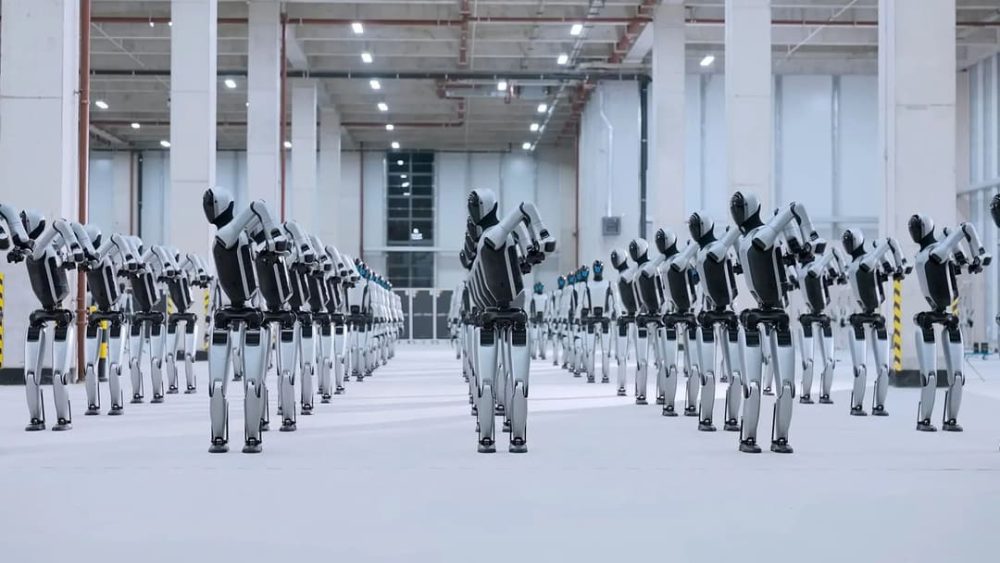
European aviation giant Airbus has signed a partnership with Chinese humanoid robotics firm UBTech Robotics to test and deploy the Walker S2 humanoid robot in aircraft manufacturing facilities.
A Big Deal
This marks a major step for Chinese robotics in global aviation, one of the world’s most demanding, precision-dependent industries. Until now, humanoid robots have largely been tested in automotive or electronics factories. Aircraft assembly, with its stringent safety, accuracy, and certification requirements, represents a new frontier.
Meet the Walker S2
- Height: ~5.8 feet (1.8 meters)
- Payload: Up to 33 pounds (15 kg)
- Key feature: Autonomous battery-swapping, can work around the clock without lengthy charging pauses.
- AI system: “Co Agent” platform for object recognition, movement coordination, and task adaptation.
- Mobility: Bipedal, with dexterous arms and hands, capable of moving in human-like environments.
What Will It Do for Airbus?
While specific tasks weren’t detailed, humanoid robots in aviation could assist with:
- Repetitive assembly line operations
- Handling components in tight fuselage spaces
- Logistics and parts movement in factories
- Inspection and quality checks
The partnership will focus on testing and validating the robot’s ability to perform reliably under real-world aviation manufacturing conditions.
Walker S2’s Growing Reach
UBTech’s robot is already being used by:
- BYD (automotive)
- Foxconn (electronics manufacturing)
- Texas Instruments (semiconductors, announced last month)
As of late December, 1,000 units had been produced at UBTech’s factory in Liuzhou, China. The company reported ¥1.4 billion ($201 million) in orders last year and expects to ship tens of thousands of robots in 2026.
The Bigger Picture
UBTech, founded in Shenzhen in 2012, became China’s first publicly listed humanoid robotics startup when it debuted in Hong Kong in late 2023.
The Airbus deal signals that industrial humanoids are moving beyond pilots and into global high-stakes production,with China’s robotics sector gaining a foothold in Western-dominated industries.
If scaled successfully, robots like the Walker S2 could reshape not just how planes are built, but how smart factories worldwide integrate human and machine labor, one battery swap at a time.