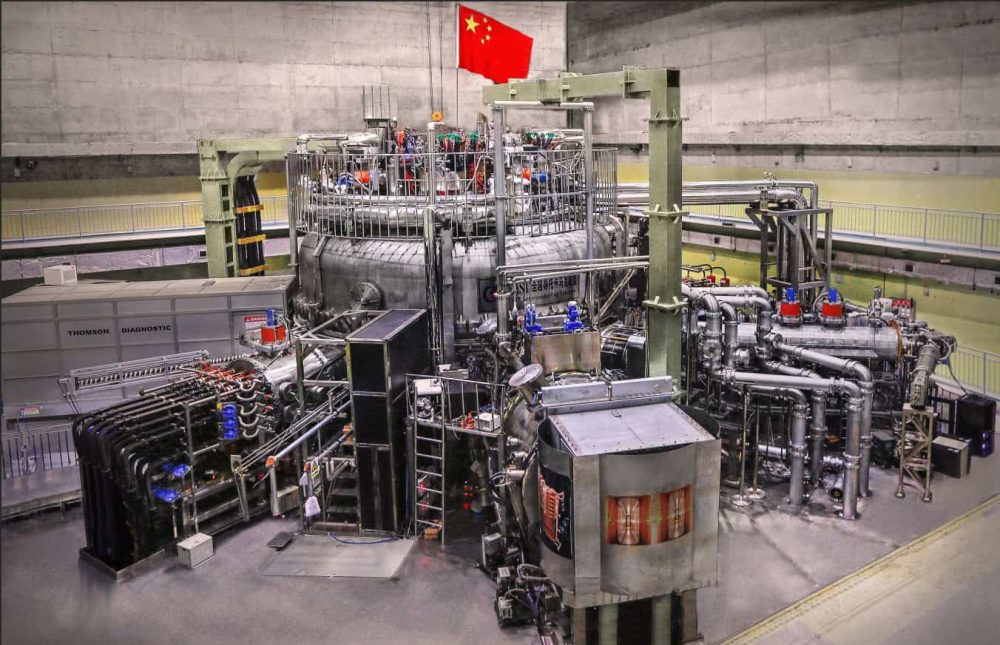
China’s Experimental Advanced Superconducting Tokamak (EAST), known as the “artificial sun,” has achieved a milestone that could redefine the future of nuclear fusion. In a study published in Science Advances, researchers announced they have shattered the long-standing Greenwald limit, a decades-old ceiling on plasma density inside fusion reactors, and maintained stable operation well above it.
Why This Matters
For years, the Greenwald limit was considered a hard barrier: push too much plasma into a tokamak, and it becomes unstable and collapses. By surpassing this limit, the EAST team has demonstrated that higher-density plasma can be controlled, which could allow future reactors to be built smaller, cheaper, and more powerful than previously thought.
How They Did It
Using a method called plasma-wall self-organization, researchers carefully heated and fueled the plasma during start-up, keeping reactor walls cleaner and cooler. This prevented impurities from destabilizing the plasma and allowed it to enter a “density-free regime,” where the old limits no longer apply.
Key Implications
- ITER boost: The multinational ITER project in France could adopt this approach to reach its goals more efficiently.
- Smaller reactors: Future commercial fusion plants may not need to be as large, reducing costs.
- Science validated: The results confirm a 2017 theoretical prediction and bridge principles between tokamaks and stellarators.
Expert Perspective
“This is not a shortcut to fusion energy, but it is a major step forward in understanding how plasma and reactor walls interact,” said Chris Eaglen, a nuclear technology expert. “It improves confidence in future reactor designs.”
What To Expect
The EAST team plans to apply this method to high-confinement operations,pushing closer to sustained, energy-producing fusion. While commercial fusion remains years away, this breakthrough moves one of humanity’s most ambitious clean-energy dreams closer to reality.