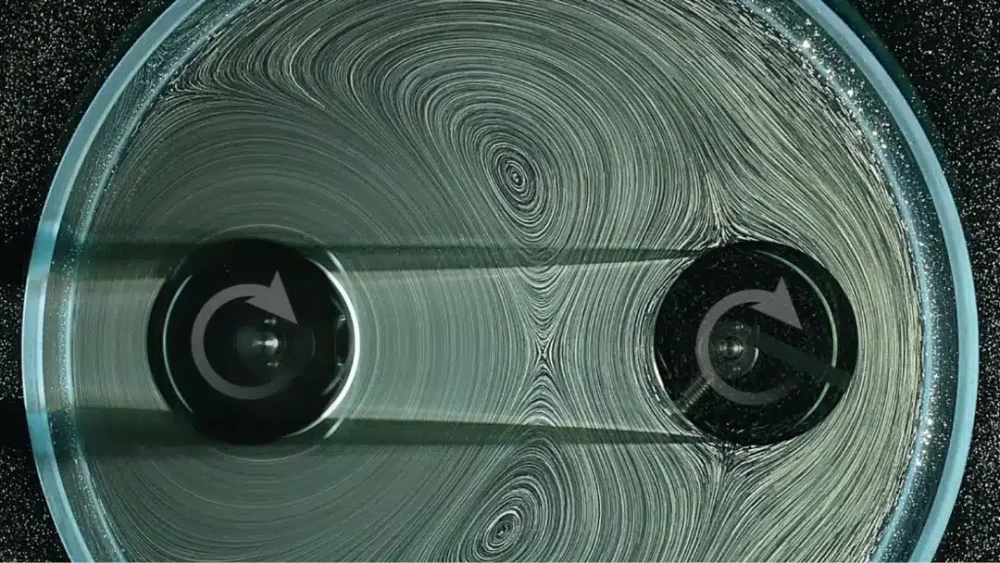
Engineers at New York University have unveiled a radical new kind of gear, one with no teeth, no contact, and no wear. By replacing solid interlocking parts with precisely controlled fluid motion, the team has created a gear system that cannot jam, never grinds down, and can change direction or speed on the fly.
How It Works
Instead of metal teeth, the system uses a viscous fluid, such as water mixed with glycerol, to transfer motion between rotating cylinders. Depending on their spacing, the fluid can act either like invisible gear teeth (spinning cylinders in opposite directions) or like a fluid belt (turning them the same way).
Because nothing touches, there’s nothing to break, jam, or wear out, debris simply flows through the liquid without disrupting operation.
Evolution
Traditional gears have been used since the Bronze Age and remain prone to failure from misalignment, grit, or fatigue.
“Fluid gears are free of all these problems,” says Leif Ristroph, associate professor at NYU’s Courant Institute. “The speed and even direction can be changed in ways not possible with mechanical gears.”
Potential Uses
- Soft robotics: Fluid-based motion for flexible, adaptive machines.
- Medical devices: Silent, sterile drives for implants and surgical tools.
- Industrial equipment: Maintenance-free operation in harsh environments.
- Renewable energy: Durable, efficient transmissions in turbines and pumps.
The Future
The research, published in Physical Review Letters, marks a foundational step toward contact-free mechanical systems. The team is now exploring scaling, optimization, and integration into real-world devices.