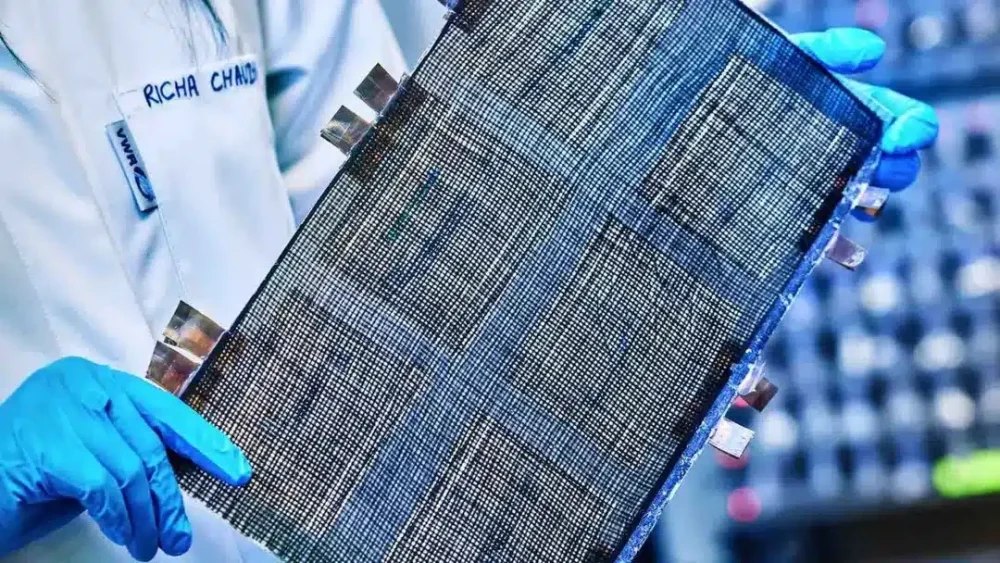
Researchers at Chalmers University of Technology have unveiled what they call the “world’s strongest” structural battery, a material that can store energy and serve as a load-bearing part of a vehicle’s frame, potentially extending electric car range by up to 70%.
How It Works
Instead of adding a heavy battery pack, this carbon fiber-based composite acts as both the positive and negative electrodes and the structural reinforcement. It eliminates traditional metal current collectors (like copper and aluminum), cutting weight significantly.
Key features:
- Semi-solid electrolyte, safer than liquid electrolytes, reducing fire and thermal runaway risks.
- Mechanical stiffness comparable to aluminum or titanium.
- Energy density approaching conventional lithium-ion batteries.
Why It’s a Game-Changer
Today, batteries are dead weight. By making the battery part of the chassis, fuselage, or body panels, vehicles become lighter and more energy-efficient.
Professor Leif Asp’s team estimates that EVs equipped with such batteries could drive up to 70% farther on a single charge. In aerospace and drones, weight savings could translate to longer flight times and greater payloads.
Where It Could Be Used
- Electric vehicles — structural battery frames or door panels.
- Aircraft and drones — integrated into wings or fuselage.
- Consumer electronics — thinner phones, lighter laptops.
- Handheld tools and robotics — longer operation without added weight.
What’s Next
While power output still needs scaling for high-demand applications, researchers say the technology is ready for industry investment and pilot projects. Next steps include:
- Improving power density.
- Establishing safety standards and regulations.
- Partnering with manufacturers for real-world integration.
The Big Picture
This isn’t just a better battery, it’s a new approach to design: why add a battery when the structure itself can be one? If successfully commercialized, structural batteries could redefine lightweight design in transportation, reduce material use, and accelerate the shift to electrification, one energy-storing frame at a time.