On a windy November day in 2025, as a small Cessna plane fought its way through 70-knot gusts over Pennsylvania, a tiny beam of energy made history. From the moving aircraft, engineers from Overview Energy successfully wirelessly transmitted electricity to a ground receiver, a seemingly modest test that could hold the key to space-based solar power.
The “Crawl, Walk, Run” Plan
The flight was the “crawl” phase in a daring three-step roadmap:
- Crawl: Beam power from a moving, turbulent aircraft to Earth, done.
- Walk: Launch a pilot demonstration satellite into low Earth orbit by 2028.
- Run: Deploy a full-scale commercial satellite in geostationary orbit by 2030, beaming megawatts of clean energy back to Earth.
Why start in a shaky airplane?
Because if you can lock onto a solar panel from a buffeted Cessna, doing it from the smooth, airless environment of space should be far simpler.
Solving the “Beachfront Property” Problem
Space solar power isn’t new, but past concepts relied heavily on microwaves, which face major hurdles:
- They require massive ground antennas (rectennas).
- They compete for the same crowded radio spectrum used by Wi-Fi, satellites, and 5G.
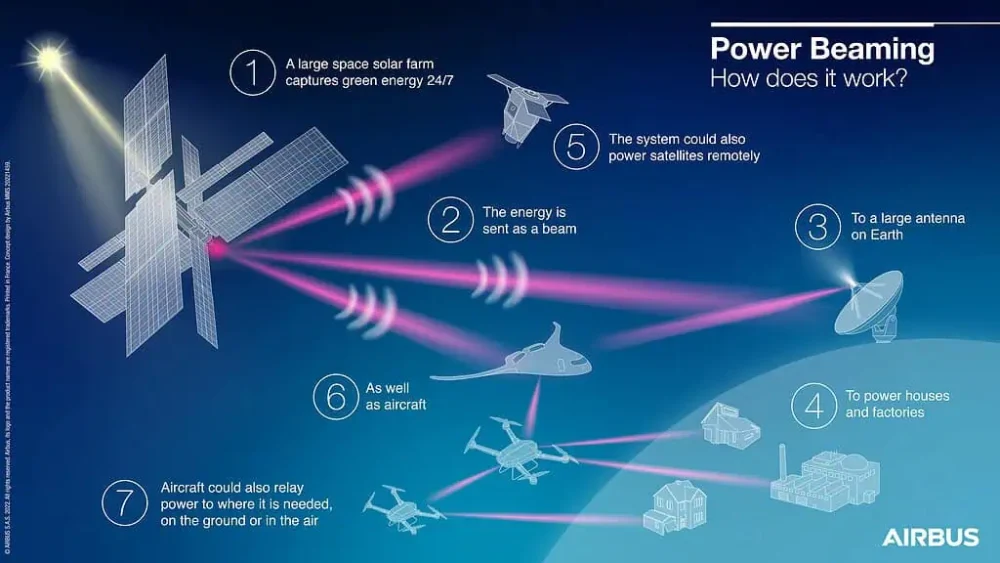
Overview Energy’s breakthrough is using near-infrared light instead.
Infrared beams don’t fight for radio spectrum.
- They can be received by standard solar panels, no need for special ground infrastructure.
- This means energy could be beamed directly to existing solar farms at night, turning intermittent solar into 24/7 baseload power.
As Paul Jaffe, Overview’s head of systems engineering and former DARPA program manager, put it:
“This actually sounds like it could work. It gets around a lot of the showstoppers.”
From Ice Batteries to Orbital Sunlight
The test itself was cleverly designed. Since the plane couldn’t power the laser with onboard solar panels, engineers used batteries. To manage heat, which in space would radiate away, they used a “thermal battery” made of ice, frozen before each flight.
The ground receiver? Just ordinary solar panels, like those on rooftops.
The Race Is On
Overview Energy has raised $20 million and faces competition from companies like Space Solar, Eternal Sun, and Extraterrestrial Power. The challenges ahead are immense, launching and assembling massive structures in geostationary orbit (36,000 km up) is astronomically complex and expensive.
But the payoff could redefine clean energy: uninterrupted solar power, rain or shine, day or night, delivered from space to anywhere on Earth.
The Bottom Line
While still early, Overview Energy’s successful airborne test proves that wireless power beaming can work under real-world, turbulent conditions. If they can scale from a Cessna to geostationary orbit, the dream of space-based solar power may finally move from sci-fi fantasy to a cornerstone of tomorrow’s energy grid.
As CEO Pablo Berte envisions it:
“Imagine sunlight collected 36,000 kilometers above Earth, then arriving as clean energy wherever the grid needs it. That’s what we’re making real.”