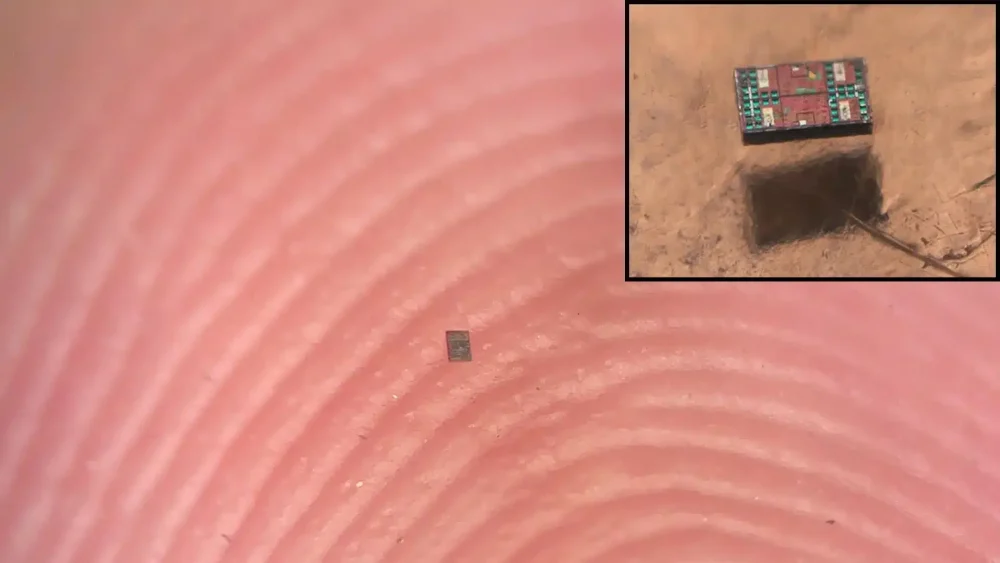
Researchers at the University of Pennsylvania and the University of Michigan have achieved a breakthrough once confined to science fiction: fully autonomous, thinking robots smaller than a grain of salt. Powered by light and equipped with microscopic computers, these devices can swim, sense their environment, make decisions, and survive for months, all without wires, magnets, or external control.
How They Work
At just 200 by 300 micrometers, each robot is comparable in size to a single-celled organism. Traditional motors don’t work at this scale, water feels like tar. Instead, they swim by generating electric fields with tiny platinum electrodes, pushing ions in the fluid to create thrust.
Onboard solar cells harvest light for power, while a microscopic computer, the world’s smallest, processes instructions, senses temperature changes, and even communicates through a coded “wiggle dance” observed under a microscope.
A Toolbox for the Future
What makes these robots revolutionary isn’t just their size, it’s their autonomy. They can be programmed individually, work in swarms, and operate in environments inaccessible to humans or larger machines. This opens staggering possibilities across multiple fields.
1. Military & Defense
- Covert Surveillance: Thousands could be dispersed in conflict zones or sensitive areas, relaying real-time data on troop movements, chemical agents, or structural integrity.
- Sentry Swarms: Deployed along borders or around high-value assets, they could detect intrusions or environmental changes and alert central command without being seen.
- Infrastructure Sabotage & Counter-Sabotage: In hybrid warfare, micro-robots could be used to disrupt enemy communications or energy grids, or to patrol and protect one’s own.
2. Medicine & Biotech
- Precision Diagnostics: Sent into the bloodstream or cerebrospinal fluid, they could monitor inflammation, detect early cancer markers, or track the progression of neurodegenerative diseases like Alzheimer’s, at the single-cell level.
- Targeted Drug Delivery: They could navigate to exact locations, a tumor, a plaque in an artery, or a specific region of the brain—and release medication only where needed.
- Microsurgery Assistants: Guided externally by light, swarms could clear clots, repair neural connections, or remove microscopic pathogens.
3. Hybrid & Asymmetric Warfare
- Information Warfare: Micro-bots could be used to physically infiltrate secure facilities and extract data from air-gapped systems.
- Psychological Operations: Invisible, undetectable sensors in public spaces could monitor crowd behavior or even influence environments, adjusting temperature, releasing unnoticeable agents, or creating “unexplainable” phenomena to sow uncertainty.
- Environmental & Agricultural Sabotage: Dispersed over farmlands or water supplies, they could selectively introduce pathogens or toxins, creating economic and public health crises without a trace.
Ethical and Security Implications
Such powerful technology does not come without risks:
- Privacy Erosion: Invisible, persistent surveillance could make personal privacy obsolete.
- Weaponization: Autonomous micro-swarms could be used for assassination, biowarfare, or societal disruption.
- Control & Accountability: Who programs them? Who stops them? The line between tool and weapon becomes dangerously thin.
What Comes Next
The current robots are simple, able to follow paths and sense temperature. But they are a platform. Future versions could carry chemical sensors, micro-manipulators, or communication relays. They could be made biodegradable for medical use, or hardened for extreme environments.
“We’ve shown you can put a brain, a sensor, and a motor into something almost too small to see,” says lead researcher Marc Miskin. “Once you have that foundation, you can layer on all kinds of intelligence.”
Invisible, intelligent, and cheap, these micro-robots are not just a lab curiosity. They are the first glimpse of a future where the smallest tools could wield the greatest influence, transforming everything from healthcare to homeland security, and forcing us to rethink the boundaries of ethics, warfare, and human control.