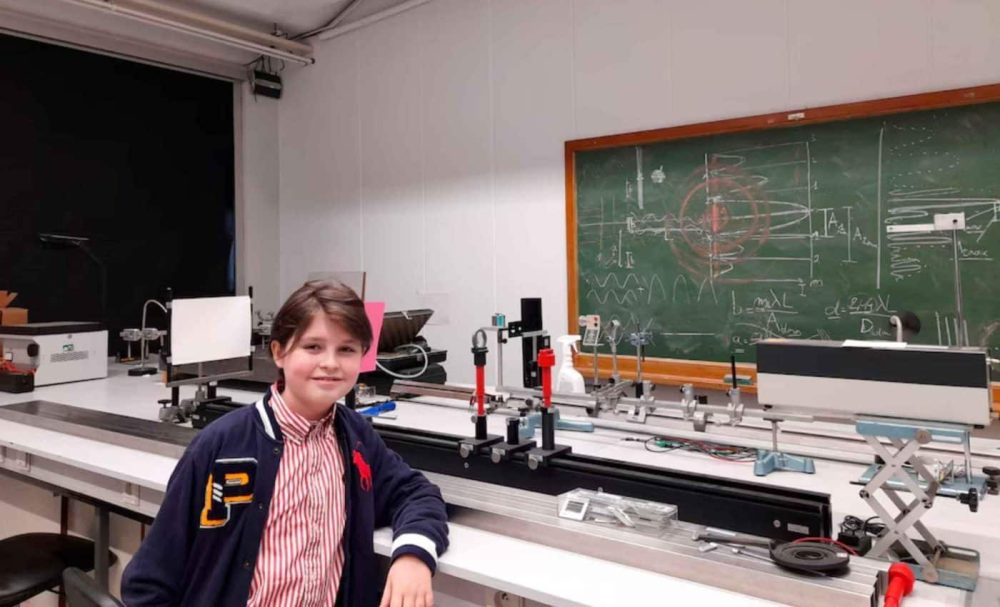
Belgian prodigy Laurent Simons has earned a PhD in quantum physics from the University of Antwerp at just 15 years old, placing him among the youngest doctoral graduates in modern history. He publicly defended his thesis in November, according to university records.
Simons first drew global attention at age 12 after completing a three-year undergraduate physics program in just 18 months. He had already finished high school at eight. Despite early interest from major U.S. and Chinese technology firms, his parents declined offers, choosing to prioritize academic depth and ethics over rapid commercialization.
His doctoral research focuses on Bose polarons in supersolids, a rare quantum state that combines crystal-like structure with frictionless flow. Using a variational theoretical approach, Simons modeled how a single particle interacts with a surrounding quantum system, work that helps scientists better understand complex many-body behavior in ultracold matter. His study was published in Physical Review X.
Shortly after completing his PhD, Simons moved to Munich to begin a second doctorate in medical science, with a focus on artificial intelligence. He has said the ultimate goal of his research is to extend healthy human lifespan, combining physics, computation, and medicine.
While media headlines have framed his ambitions as creating “superhumans,” Simons has emphasized measurable progress in healthcare rather than science fiction outcomes. His work now shifts from fundamental physics toward applied medical research, where AI-driven analysis could support diagnostics, screening, and drug development.
Although he is not the youngest PhD holder on record, Simons’ path stands out as one of the clearest modern examples of accelerated learning backed by peer-reviewed research and documented academic milestones.