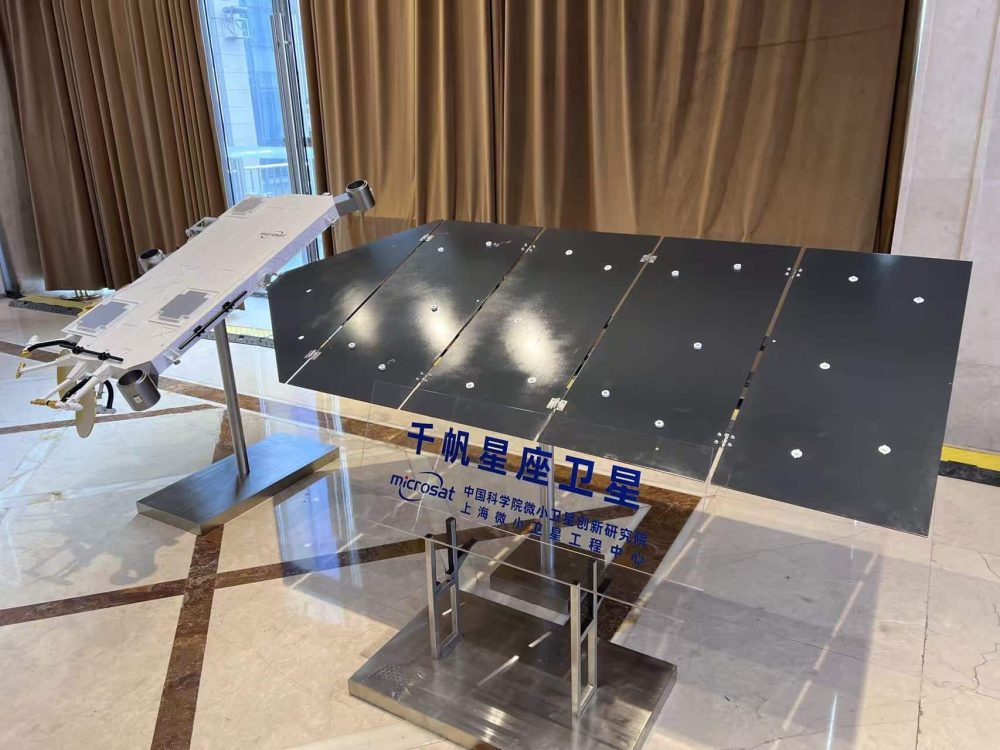
Elon Musk’s Starlink has been racing across the skies, striking deals with airlines and dominating the low-Earth orbit (LEO) satellite market. But China is now rolling out something far more ambitious, and far more strategically pointed. Meet Qianfan, or “A Thousand Sails”, Beijing’s answer to Starlink and the centerpiece of China’s grand plan to control the next era of global connectivity. Your next flight aboard an Airbus jet in Asia might be connected not by Starlink… but by China’s Starlink rival.
A Mega-Constellation With Mega-Ambitions
Revealed at the 2025 Satellite Internet Industry Ecosystem Conference in Shanghai, Qianfan is quickly transforming from a national project into a global power play. The constellation has already deployed 108 LEO satellites, modest compared to Starlink’s 6,300+ active orbiters, but China has no intention of staying modest.
The Spacesail Program (Qianfan’s official name) plans to launch 15,000 satellites, forming a low-latency, high-bandwidth network designed for everything from 6G, autonomous driving, and remote communications, to — now officially — in-flight Wi-Fi.
China demonstrated the system’s early stability by maintaining continuous communication for 120 minutes across 19 satellites, and application tests in Malaysia, Mongolia and Kazakhstan have already reported positive results. In other words: the global rollout has quietly begun.
Airbus Just Opened the Door
The headline that sent shockwaves across the industry: Shanghai Yuanxin Satellite Technology has signed a strategic in-flight connectivity deal with Airbus.
Airbus will integrate Qianfan into its High Bandwidth Connectivity Plus antenna system, the same platform that supports satellites from SES, Hughes and soon Amazon’s Project Kuiper.
This gives Chinese airlines a convenient, politically aligned alternative to Starlink. Airbus calls it an “additional IFC option,” but let’s be honest: this is a direct challenge to SpaceX’s dominance in the aviation sector.
The message from China is clear:
If Starlink won’t be allowed in Chinese airspace, China will build a competitor strong enough to take the skies elsewhere.
The Bigger Race: A New Space Internet Empire
The Shanghai conference painted a picture of an ecosystem in overdrive. Satellite launches in China have grown 11× in ten years, and the country plans to conduct around 500 launches between 2026 and 2030 to meet demand for 7,000 next-generation satellites.
By 2030, China expects its satellite internet market to hit 1 trillion yuan (~US$141 billion).
Starlink may have a massive head start, but China’s industrial machine grows louder by the day.
Institutions like the Chinese Academy of Sciences, Fudan University, Shanghai Spacecom, national telecom giants, and dozens of manufacturers are now locked into a coordinated plan to build a “space-air-ground” network that directly rivals, and eventually hopes to surpass, Starlink’s reach.
Starlink vs. Qianfan: The First Real Global Rivalry
SpaceX still operates the world’s only functional mega-constellation, but China is attacking from every angle, aerospace, telecoms, national policy, and now commercial aviation.
Qianfan is still in its early days with just 108 satellites. But the playbook isn’t subtle:
Build the constellation, secure the airlines, win the developing world, and challenge Starlink everywhere Musk cannot legally enter.