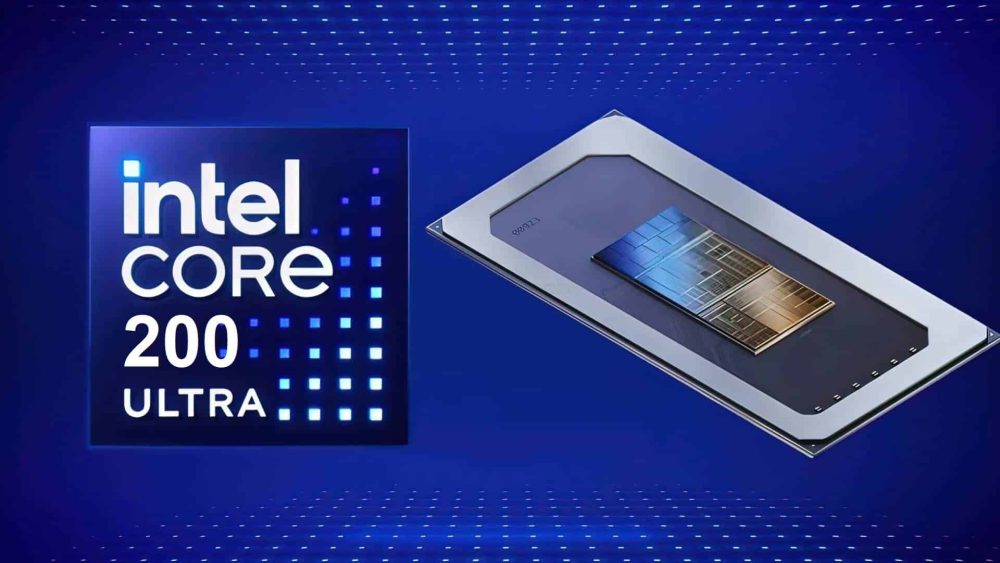
Intel has acknowledged that it cannot meet the current demand for its latest Core Ultra 200-series processors, openly stating that the company simply did not secure enough wafer capacity from TSMC. Both Lunar Lake and Arrow Lake rely on TSMC’s advanced N3B (3nm-class) node for their logic tiles, while Intel handles packaging in-house. When placing its orders with TSMC, Intel acted conservatively, a decision now limiting its ability to ship more chips.
Speaking at the UBS Global Technology and AI Conference 2025, Intel Corporate VP John Pitzer put it bluntly:
“If we had more Lunar Lake wafers, we would be selling more Lunar Lake. If we had more Arrow Lake wafers, we would be selling more Arrow Lake.”
Strong PC Demand Meets Limited TSMC Capacity
Despite a cooling PC market overall, demand for Intel’s new AI-accelerated client systems is still strong. But TSMC’s cutting-edge manufacturing lines are notoriously full, leaving Intel unable to expand supply quickly. Both Arrow Lake and Lunar Lake depend on TSMC’s premium 3nm capacity, and Intel has to compete with Apple, AMD, Nvidia, and others for the same high-end wafers.
Intel expects supply to improve in Q4 and beyond, but it has not promised that this will be enough to clear existing backlogs. On the positive side, the company says it has sufficient LPDDR5X memory for Lunar Lake’s on-package DRAM, meaning no sudden cost spikes in the near term.
However, with wafer shortages, rising DRAM prices, and tight inventory, market watchers are already asking whether Intel will eventually raise CPU prices.
Server CPUs Face a Similar Issue
The supply constraints don’t stop at client processors. Intel’s server business, especially its newest Xeon 6 “Granite Rapids” processors built on the Intel 3 node, is also capacity-limited. Although Intel has spent billions upgrading its fabs with EUV tools, the bulk of its production capacity still sits on older 10nm-class (Intel 7 and SuperFin) lines.
Pitzer summarized the situation:
“If we had more Granite Rapids wafers, we would be selling more Granite Rapids.”
Intel recently even reallocated Intel 7 wafers to prioritize Granite Rapids I/O tiles, reinforcing how tight capacity has become.
A Turning Point: Panther Lake Brings Production Back In-House
The company emphasized that this situation is temporary. Starting with Panther Lake, set to debut at CES 2026, Intel plans to bring all logic die production back to its own fabs as its advanced 18A node matures. This marks a major shift from the current generation, where Arrow Lake and Lunar Lake rely 100% on TSMC for compute die manufacturing.
Looking further ahead, Nova Lake (late 2026) is also expected to return to internal manufacturing, with a tiled architecture pairing dual compute tiles with a separate SoC tile. Intel may still outsource the SoC tile, but the bulk of high-performance logic is planned to come from Intel Foundry.
Until then, Intel’s biggest challenge is simple: too much demand, not enough wafers.